
Luxury brands have long viewed sport as a platform to integrate themselves into culture in a way that upholds their brand identity and communicates precision, performance, and prestige. However, Mercedes-Benz demonstrated that sponsorship at the 2025 Berlin Open moved beyond banners, logos, and hospitality suites into a reimagined, playable experience. This German automaker and the Women’s Tennis Association (WTA) have combined sport and design to introduce an innovative, unique three-sided tennis court.
Reimagining the tennis court
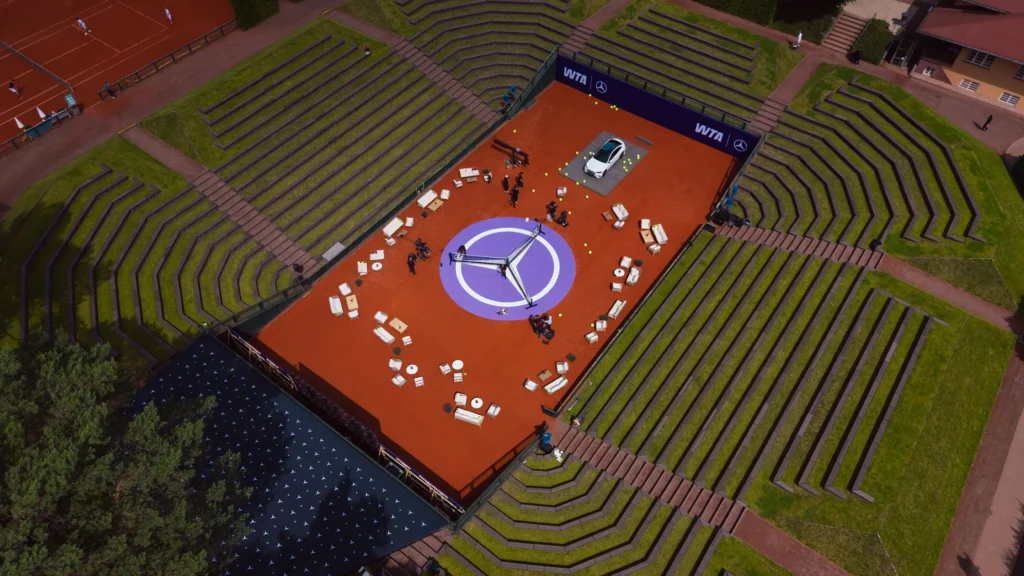
This three-sided tennis court is shaped by its iconic three-pointed star logo, resembling the Mercedes-Benz emblem from a bird’s-eye view. Instead of a traditional rectangular layout, there are three individual courts that radiate from a single central point to create a star-shaped playing court. These characterise the Mercedes-Benz Signature Court, which rewrites how users can play tennis.
Rather than competing against one or two opponents on the other side of the court, three players can participate simultaneously. Each player can pass shots to the opposing courts, reimagining traditional tennis in a new game that blends conventional tennis skills with novelty.
To ensure the format remains entertaining and accessible, Mercedes-Benz and the WTA have implemented simplified rules for this court, including volleys and modified serving patterns that encourage rallies and continuous movement.
This unique court was developed as an extension of the Mercedes-Benz brand itself, with Christina Schenck, Head of Marketing Communications, describing the installation as a way to bring the company’s iconic logo “to life” by transforming it into a playable, immersive experience.
Launching alongside the Berlin Tennis Open
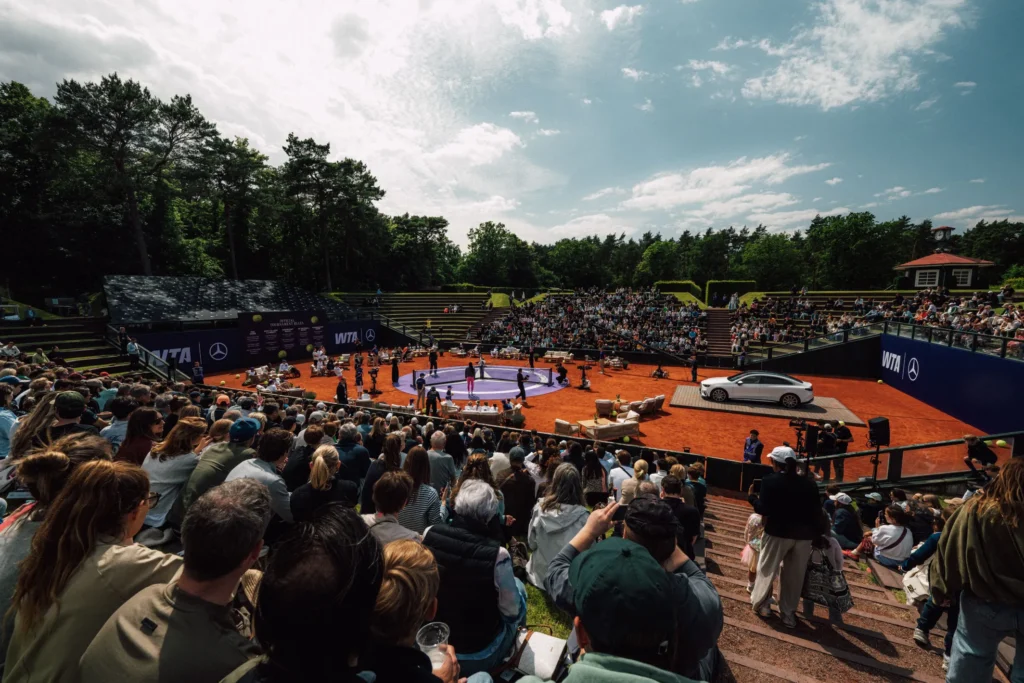
The debut of this court launched alongside the Berlin Tennis Open, one of the WTA Tour’s premier grass-court events in the lead-up to Wimbledon. Mercedes-Benz officially unveiled the court through a special exhibition attended by approximately 1,500 spectators. The event featured exhibition matches involving many of the WTA’s biggest names, including players such as Coco Gauff, Paula Badosa, Eva Lys, Clara Tauson, and former Wimbledon finalist Sabine Lisicki.
Following the launch, the Mercedes-Benz Signature Court was opened to Berlin Open ticket holders, allowing the public to experience the court for themselves and extending the activation beyond a media spectacle into a hands-on, immersive experience.
More than a sponsorship
The Signature Court illustrates how sponsorship has evolved in the digital age. Historically, sponsorship focused largely on visibility, with brands heavily investing in advertising boards and branded apparel to maximise exposure during televised events. However, in today’s contemporary marketing environment, brands are prioritising experiences instead due to their ability to generate engagement and customer involvement, enabling audiences to create lasting memories.
Instead of interrupting audiences with promotional messages, the integration of its logo into a playable experience embeds its identity into the installation itself, creating a strong emotional connection and memorability among audiences.
Strengthening the WTA
This installation additionally reflects Mercedes-Benz’s expanding partnership with the Women’s Tennis Association. This luxury brand has become one of the WTA’s most prominent commercial partners, supporting approximately 30 global tournaments and providing transportation through its “Welcome Home” initiative.
Women’s tennis appears to be an increasingly attractive platform for luxury brands, as it enables prestige and premium positioning within a large audience. Tennis combines international visibility with a growing roster of marketable athletes whose influence extends beyond the competition.
Mercedes-Benz’s collaboration with the WTA epitomises this perspective, feeding off tennis’s growth while aligning its brand with values such as excellence, resilience, and innovation.
Coco Gauff and the new C-Class
This Signature Court was not developed in isolation. Its launch coincided with Mercedes-Benz’s campaign for the CLA, featuring global brand ambassador Coco Gauff. As one of the most recognisable figures in women’s tennis, Gauff has played a significant role in Mercedes-Benz’s sports marketing by connecting with a younger and more diverse audience. Rather than simply appearing in advertising material, Gauff helped introduce the innovative playing format, playing a pivotal role in its launch.
What now?
Although the Signature Court was built as a temporary installation for the Berlin Tennis Open, its influence extends beyond the single tournament. By transforming its famous three-pointed star into a functioning tennis court, Mercedes-Benz demonstrated that experiential marketing can be simultaneously playful, strategically aligned, and commercially effective.
Written By: Leah Kim
Published On: 29th June 2026