
Most fashion-and-car tie-ins are pretty transparent as marketing: pick a special colour, slap a logo somewhere visible, call it exclusive. This Porsche moves beyond that. Louis Vuitton and Singer Vehicle Design built an exclusive vehicle for Monterey Car Week 2026; the two companies unveiled a pair of one-off Porsche 911s, shaped by Singer’s obsessive reimagining process and Louis Vuitton’s travel, leather and watchmaking history. First co-branded car project either company has ever done.
One’s a saffron-and-cobalt-blue coupe with a naturally aspirated 4.0-litre air-cooled flat-six. The other, developed with Louis Vuitton Women’s Artistic Director Nicolas Ghesquière, is a Classic Turbo Cabriolet in Calcaire Lutétien white, wood trim, twin-turbo 3.8-litre.

It Started With a Dashboard Clock
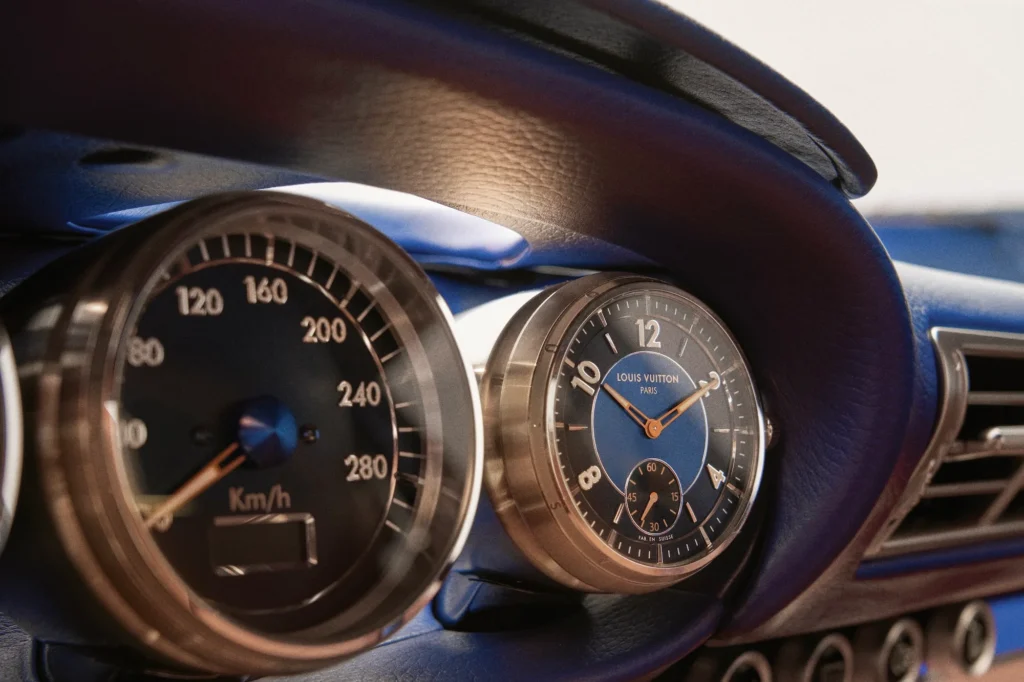
Louis Vuitton was first approached about making a dashboard clock for a Porsche being reimagined by Singer. La Fabrique du Temps Louis Vuitton, its Swiss watchmaking manufacture, built the piece.
The project didn’t stop at the clock. The teams recognised that the same level of craft could run through the whole car, and the dashboard timepiece became the starting point for reworking the entire interior.
That’s what separates this from a typical fashion tie-in. Louis Vuitton didn’t just supply luggage or apply a monogram to a few surfaces. Its own designers and artisans worked on the actual architecture of the cabin.
The instrument cluster borrows visual ideas from the Tambour watch: new typography, new hands, new index treatments on the speedometer and tachometer, with a colour palette built to match the clock beside them.
In the coupe, the clock is removable and works as a standalone desk clock outside the car. It’s a small detail, but it captures the project’s logic: even a component that could have stayed permanently fixed was treated as its own crafted object.
A 911 in Louis Vuitton’s Colours
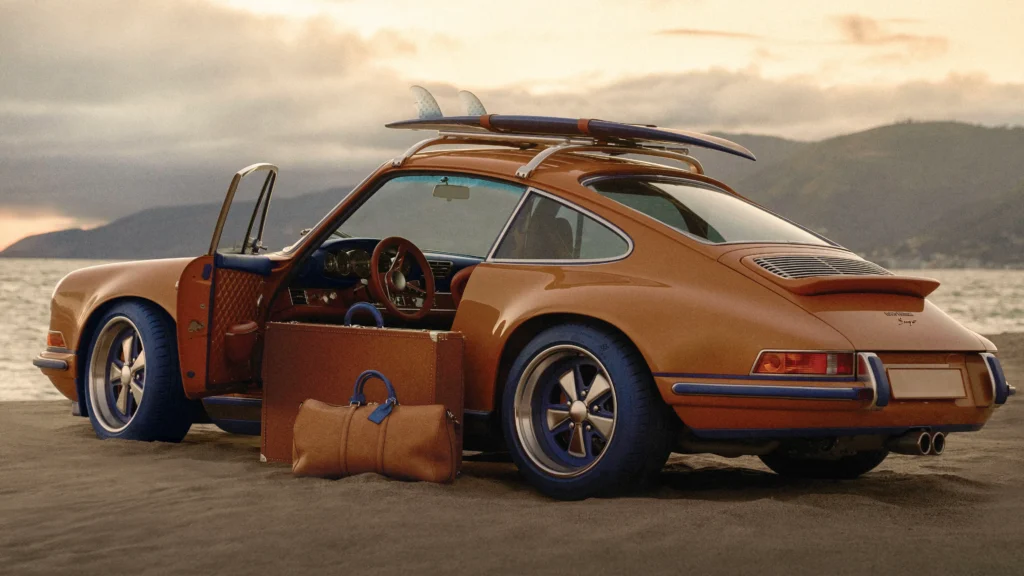
Built on a Type 964 coupe, the Singer Classic wears saffron, cobalt blue and yellow. The carbon-fibre body keeps the 911’s familiar proportions, but the colours make its identity unmistakable.
The palette isn’t arbitrary. Saffron has deep roots in Louis Vuitton’s history, and pairing it with cobalt recalls Bahama Yellow, a shade tied to some of Singer’s earliest commissions. The wider scheme also references Louis Vuitton’s history with travel trunks.
That history is concrete, not just a mood board. Louis Vuitton produced travel cases for motoring as far back as trunks built for Citroën in the 1920s. This 911 moves that history from the luggage rack onto the car itself.
The roof rack makes the point literally. Built to carry a trunk, a surfboard or skis, it turns the car into something built around a journey rather than a weekend drive. A custom oak-and-walnut surfboard can ride above the car. Even the tyres get a cobalt-blue treatment, and the rear engine intake carries a subtle geometric take on the Louis Vuitton initials. The references are extensive, but they read as integrated rather than applied.
The Interior Is Where Things Get Serious
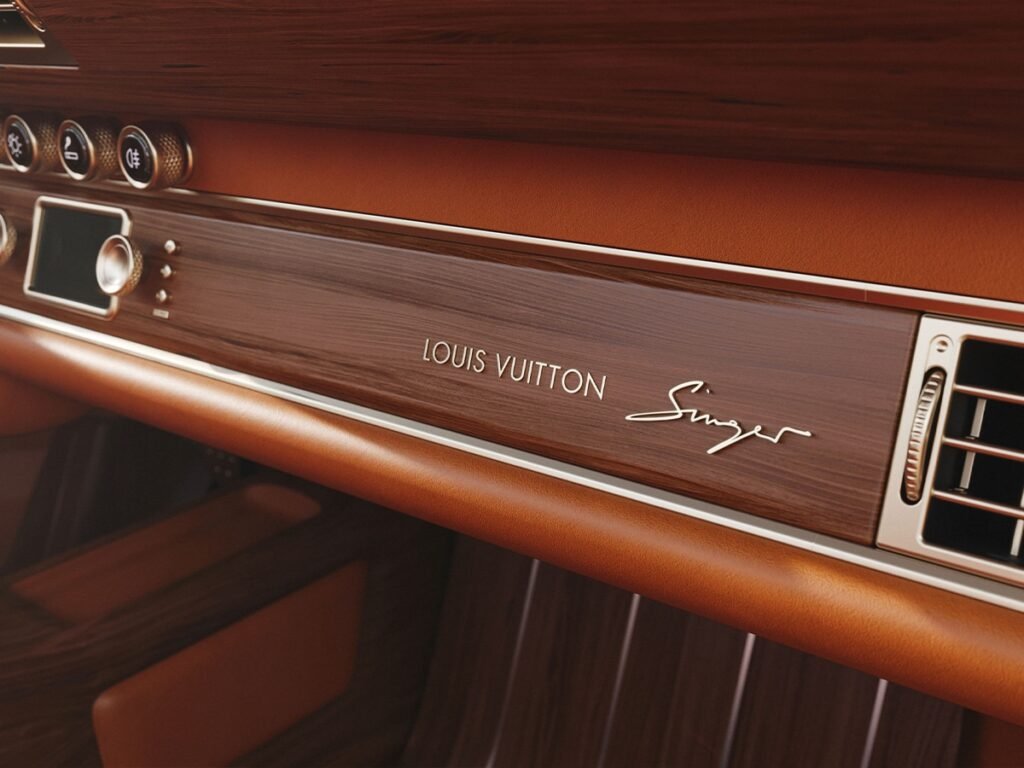
The exterior draws attention. The cabin is where the collaboration goes deepest. The leather matches what Louis Vuitton uses across its luggage line, with yellow stitching for contrast and diamond-patterned panels echoing the malletage construction found in its trunks. Touch is where it stands out most. The standard plastic controls are gone, replaced with individually crafted metal components. Every switch, knob, lock and vent is finished using techniques closer to fine watchmaking than automotive production.
That distinction matters. Most luxury interiors focus on materials that look expensive. This one is built so that using the car feels expensive too, so that turning a dial becomes part of the experience rather than an afterthought. Singer is a natural partner for that approach. The California company built its reputation reworking classic 911s down to the smallest engineering and material detail without losing what made the originals distinctive. This project extends that same instinct further.
Beneath the Luxury, There Is a Serious Driver’s Car
It’s easy to focus on the leather and the watchmaking and forget these are still Singer builds underneath. The coupe runs a lightweight carbon-fibre body on a 964 chassis, a naturally aspirated 4.0-litre flat-six, a six-speed manual, and carbon-ceramic brakes. Published output puts it around 400 bhp. That matters, because this could easily have become a static luxury object instead. It doesn’t. Singer’s core philosophy is that these cars are meant to be driven, and the craftsmanship here supports that experience rather than replacing it.
Enter Nicolas Ghesquière
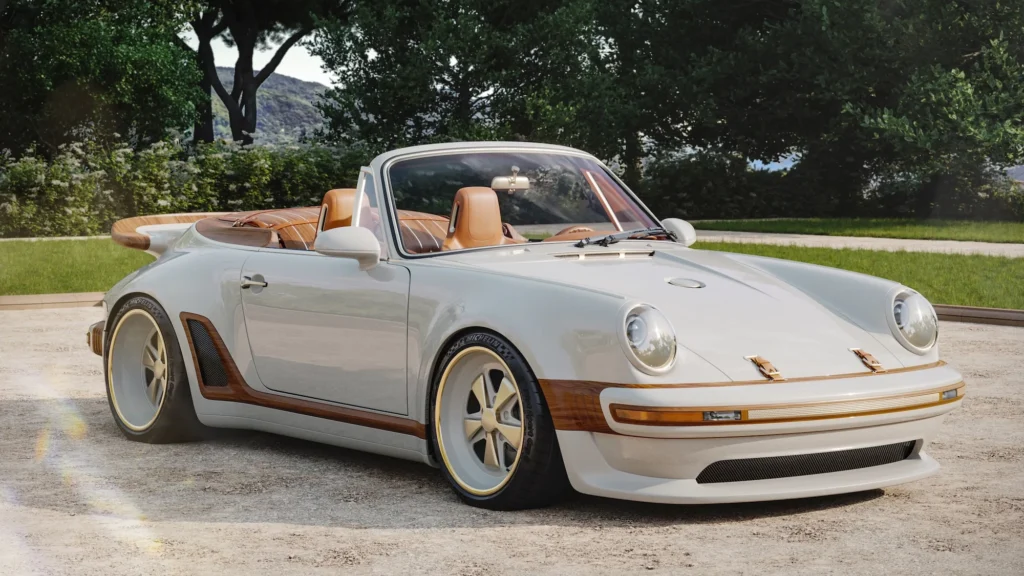
The second car takes a different direction. Built on Singer’s Classic Turbo Cabriolet and developed with Nicolas Ghesquière, it trades the coupe’s luggage-and-road narrative for something closer to a boat.
The Clock Finds a New Home
The dashboard clock sits differently in the cabriolet, positioned on the centre console near the gear lever rather than in the main instrument cluster. Its dial and gold detailing are built to work with the white exterior and wood-lined cabin.
In the coupe, the clock reads as part of a reworked classic dashboard. In the cabriolet, it feels closer to a piece of jewellery placed in the cockpit, which fits the character of each car: the coupe built around the road and the journey, the cabriolet around open-air driving and the feel of wood, leather and sunlight.
The Car Comes With Its Own Wardrobe
Louis Vuitton didn’t stop at the cars. Each comes with a bespoke collection of clothing, luggage and accessories built around its individual aesthetic. The saffron coupe includes a leather driving jacket, denim, driving shoes, gloves and a custom helmet. The Turbo Cabriolet receives a made-to-measure driving suit, braided leather gloves, its own footwear and helmet.
A Return to Louis Vuitton’s Automotive Past
The partnership feels contemporary, but Louis Vuitton frames it as a return to something already embedded in its history. The house’s relationship with travel began with luggage, and as the automobile became central to travel in the early twentieth century, Louis Vuitton built trunks and accessories specifically for motoring. It even produced its own car in 1909.
That history gives the project more weight than a typical brand collaboration. The car isn’t an arbitrary new category for Louis Vuitton. It’s an extension of the same idea the house has pursued for over a century: making travel more practical, more personal and more beautiful.
Singer represents the modern version of that same instinct. Founded in California in 2009, the company has built its name restoring and reimagining 964-generation 911s with an exacting mix of design, engineering and craft. The partnership connects two histories that share the same underlying priority: detail.
More Than a Fashion Collaboration
What stands out is that neither side simply borrowed the other’s identity. Louis Vuitton contributed watchmaking, leatherwork, luggage expertise and a philosophy of travel. Singer contributed engineering, restoration and its own interpretation of the 911.
The result is neither a fashion accessory nor a conventional restomod. It occupies the space between the two, where automotive engineering becomes a platform for craft from entirely different disciplines.
The dashboard clock is the clearest evidence of that. It was the small detail that revealed how naturally these two worlds could overlap: a watch becomes part of a car, a trunk becomes a luggage compartment, a leather technique developed for handbags shapes a car interior, a fashion designer approaches a sports car through the visual language of a motorboat.
With the resources of two companies, this focuses on the details behind it. The two cars are ultimately about travel itself: not simply where a car can take you, but what the journey feels like while you’re in it.
At a moment defined by digital interfaces, electrification and mass-produced luxury, these two cars represent the opposite: mechanical watches, manual gearboxes, air-cooled engines, hand-finished metal, natural leather and carefully made luggage. Deliberately analogue, deliberately excessive and deliberately unique.
Written By: Leah Kim
Published On: 14th August 2026