
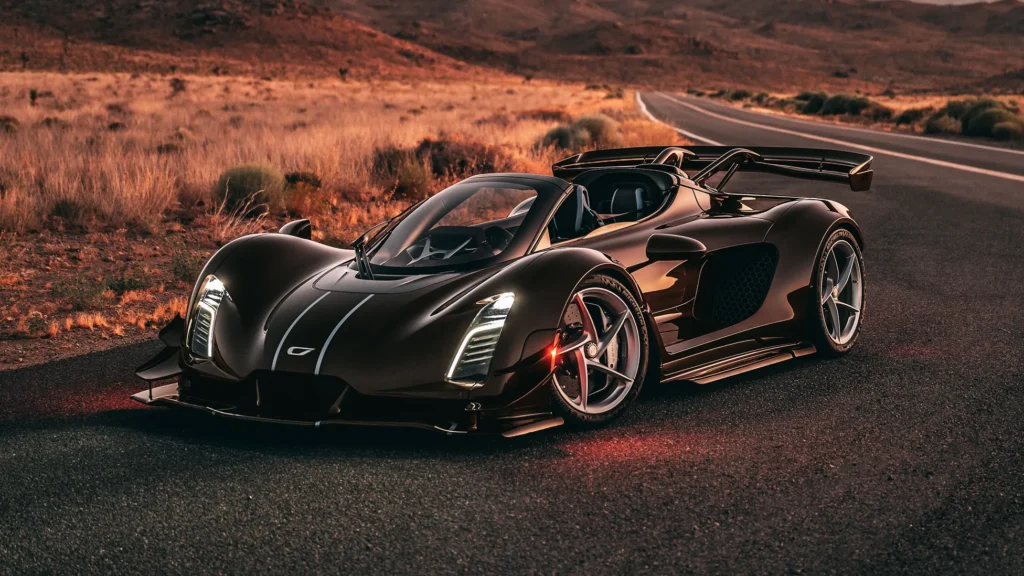
Few cars make the phrase “open-air driving” sound like a threat. The new Czinger 21C Spyder is one of them. Revealed in August 2026, the Spyder is the latest evolution of Czinger’s radically engineered 21C hypercar, transforming an already extreme machine into an open-top, road-legal weapon. It combines a 1,250-horsepower hybrid powertrain, a tandem cockpit, extensive 3D-printed construction and an aerodynamic package capable of generating more than 3,200 pounds of downforce. Just 30 examples are planned, with prices starting at US$2.75 million.
Yet the missing roof is arguably the least interesting thing about it. The 21C Spyder is a showcase for Czinger’s broader philosophy: use advanced software, additive manufacturing and unconventional engineering to rethink how an ultra-high-performance car should be designed and built.

A hypercar without a conventional cockpit
Czinger has never followed the conventional hypercar template. The 21C’s most obvious departure from the norm is its seating arrangement. Instead of placing two occupants side by side, the car uses a tandem layout, positioning the driver in front and the passenger directly behind. It gives the cockpit an almost aviation-inspired character, while allowing the body to remain extremely narrow through its central section. The Spyder retains this arrangement, with the passenger sitting beneath the air intake positioned above the cockpit.
Taking the roof away
Removing the roof from a high-performance car typically introduces a structural problem. A fixed roof contributes to the stiffness of the vehicle, so converting a coupe into a convertible can mean adding substantial reinforcement, and therefore substantial weight. Czinger’s carbon-fibre and 3D-printed structure is sufficiently stiff that the Spyder did not require a fundamental redesign of its architecture. The company added approximately 22 pounds of additional carbon fibre around the windscreen and A-pillars to provide the necessary structural reinforcement. The removable roof panel itself weighs roughly the same amount.
The roof is a carbon-fibre structure incorporating a transparent polycarbonate section. It is manually removed using two latches inside the cabin and can be stored on a dedicated stand designed to match the car. For owners caught by an unexpected change in weather, Czinger has also engineered a compact emergency soft top that can be stored within the vehicle. More importantly, removing the roof does surprisingly little to the car’s aerodynamic performance.

Downforce with the sky above you
Czinger claims the 21C Spyder can produce up to 3,307 pounds of downforce at 150 mph with its carbon roof fitted. With the roof removed, that figure falls only slightly, to 3,267 pounds. That means the open car sacrifices only a small amount of aerodynamic load despite losing its roof panel.
Czinger positions the Spyder as the world’s highest-downforce open-top road car, with the company quoting 3,267 pounds, or approximately 1,482 kilograms, at 150 mph with the roof removed. Top Gear and Octane both highlight the extraordinary figure as one of the car’s defining engineering achievements. The important detail is that Czinger did not simply compensate for the missing roof with a larger wing. The Spyder retains the high-downforce body configuration associated with the 21C HDF, rather than adopting the sleeker, low-drag VMax specification.
It may be a convertible, but it has not been designed primarily around leisurely open-top cruising. Its aerodynamic package is there to keep the car planted when speeds become serious.
1,250 horsepower from three forms of propulsion
Underneath the dramatic bodywork sits a hybrid system that combines a small-displacement internal-combustion engine with three electric machines. The heart of the system is a 2.88-litre, twin-turbocharged, flat-plane-crank V8 producing 750 horsepower. It revs to 11,000rpm, an extraordinary ceiling for a road-going engine. Two electric motors drive the front wheels, while a crankshaft-mounted motor-generator unit contributes to the hybrid system. Combined output reaches 1,250 horsepower and 691 lb-ft of torque in the car’s most aggressive setting.
The result is an unusual all-wheel-drive arrangement. The V8 drives the rear wheels, while the electric motors provide propulsion at the front, delivering immediate electric torque and additional traction. Czinger says the Spyder can accelerate from 0 to 60 mph in approximately 1.9 seconds and reach a top speed of 205 mph with the hardtop fitted.
There is also a degree of flexibility beneath the headline figures. The four drive modes: Street, Sport, Track and Track+, allow the car’s character to change substantially. In Street mode, the Spyder can operate on electric power alone below 60 mph, while Track+ lowers the ride height by 25mm and increases damper stiffness by 50 per cent.
The brakes may be its biggest innovation
The most intriguing technology in the Spyder may not be the hybrid powertrain or the removable roof. It is the braking system. Czinger calls it BrakeNode. Instead of treating the suspension upright, brake caliper and hydraulic lines as separate components joined together during assembly, BrakeNode integrates them into a single 3D-printed aluminium structure. The concept eliminates conventional mounting interfaces and incorporates the hydraulic passages directly into the component.
The benefits are primarily about weight, stiffness and packaging. Czinger says BrakeNode reduces unsprung mass by around 1.5 pounds at each corner compared with the already lightweight components used by the conventional 21C. The company also claims an increase in stiffness of up to 30 per cent and braking distances shortened by as much as 15 per cent.
Octane reports that the Spyder uses six-piston front callipers with titanium pistons and 410mm carbon-ceramic discs, while the rear brakes use 390mm discs with aluminium pistons. Perhaps more interestingly, BrakeNode is not necessarily exclusive to new customers. Czinger says the technology can be retrofitted to existing 21C HDF and VMax models.
That makes the Spyder more than another body style. It becomes a rolling development platform for technology that could potentially influence the wider 21C family.
A dashboard made like the rest of the car
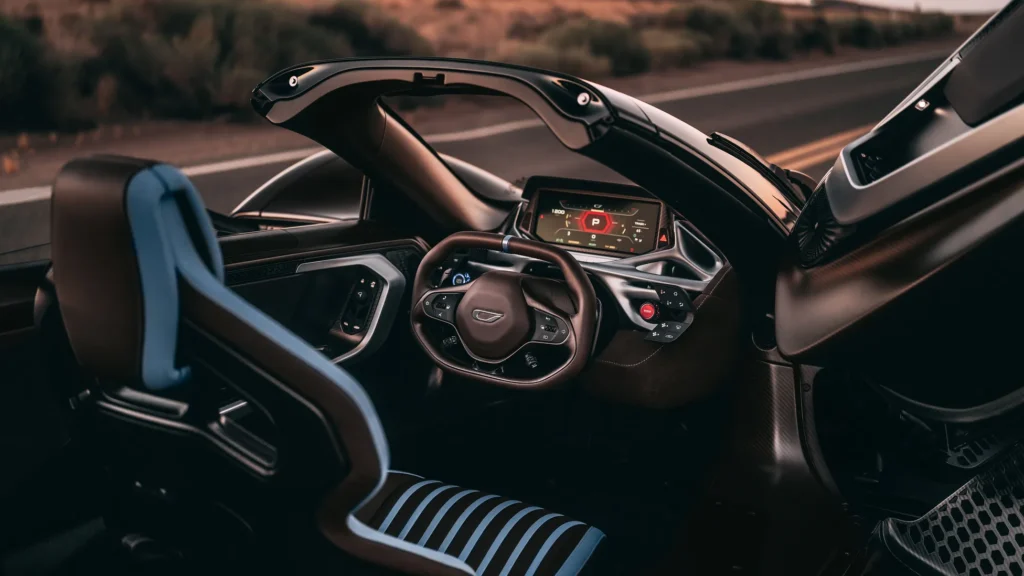
Czinger’s additive-manufacturing philosophy continues into the cabin. The Spyder introduces what the company calls NeuralNode, an intricate 3D-printed structure that incorporates elements of the dashboard, ventilation and controls into a single lightweight form. Rather than covering the interior with layers of conventional trim, the structure itself becomes the design.
Air from the climate-control system is channelled through integrated passages within the structure before being directed into the cabin. The steering wheel and various controls are incorporated into the same architectural approach.
Czinger was founded by Kevin Czinger and his son Lukas, with the vehicle company emerging from the wider Divergent Technologies business. Divergent specialises in advanced additive manufacturing, using algorithmic design and 3D-printed metal components for sectors including automotive and aerospace. The 21C was conceived in part as a demonstration of what that manufacturing philosophy could achieve when applied to a complete high-performance vehicle.
A new way to build a hypercar
The importance of the 21C Spyder therefore extends beyond its headline numbers. Traditional automotive manufacturing depends heavily on established processes: castings, forgings, machined parts, multiple brackets, fasteners and assemblies designed around the limitations of conventional production.
Its BioLogic engineering approach uses algorithmic and generative design to determine where material is actually required for strength, stiffness, packaging and aerodynamic performance. Additive manufacturing then allows those geometries to be produced in ways that would be extremely difficult, or impossible, through traditional manufacturing.
The resulting components can look organic, almost skeletal. But their unusual appearance is not simply aesthetic theatre. The shapes are consequences of designing around structural requirements rather than forcing those requirements into conventional manufacturing methods. The Spyder makes that philosophy particularly visible because its BrakeNode and NeuralNode systems are central parts of the vehicle’s architecture.
Exclusivity comes built in
Only 30 examples of the 21C Spyder will be produced, with each car hand-built at Czinger’s Area 21 facility in Los Angeles. Buyers will be able to specify bespoke configurations, meaning the final cars are likely to vary significantly from one another.
The starting price is US$2.75 million before options. MotorTrend reported that a highly specified example displayed during the car’s unveiling would cost approximately US$3.25 million, demonstrating how quickly the price can climb once personalisation enters the equation. For a vehicle limited to 30 units, that exclusivity is hardly surprising.
But the Spyder’s rarity is also part of its role as a technological statement. Czinger is not attempting to sell thousands of these cars. It is demonstrating what its manufacturing philosophy can accomplish at the end of the market.
The American hypercar gets stranger
The 21C Spyder arrives at an interesting moment for the hypercar industry. Europe has historically dominated the category through names such as Ferrari, McLaren, Lamborghini, Bugatti and Pagani. The American response has increasingly come not through conventional V8 muscle-car thinking, but through technology-driven companies willing to approach the automobile differently.
Czinger is arguably one of the most radical examples. The 21C Spyder does not merely compete on horsepower. Its selling points include additive manufacturing, algorithmic design, tandem seating, hybrid all-wheel drive, extraordinary aerodynamic load and integrated braking technology.
An open-top machine with very little compromise
The irony of the 21C Spyder is that taking the roof away has not made it gentler. It has made the experience more extreme. The driver is placed directly in the open air, behind a 1,250-horsepower hybrid powertrain and inside a cockpit designed around a central seating position. Above 150 mph, the car is capable of producing extraordinary aerodynamic load, while its 11,000rpm V8 provides the soundtrack. And when it is time to slow down, a radically redesigned braking system turns 3D printing into a performance technology rather than a novelty.
It is not simply the convertible version of an existing hypercar. It is a concentrated expression of what Czinger believes the modern performance car can become when software, manufacturing and mechanical engineering are treated as one discipline.
Written By: Leah Kim
Published On: 17th August 2026