
There are luxury stores designed to sell products, and there are places designed to make shopping feel almost incidental. Hermès’ new London Maison belongs to the second category.
At 166 New Bond Street, the French house has built a sprawling new home that reads less like a boutique and more like an architectural journey. Opened in June 2026, the Maison occupies almost 2,000 square metres across six interconnected historic buildings and five floors, bringing together the house’s sixteen métiers in a space built for discovery rather than efficiency. Hermès has resisted the obvious move of turning that much space into a giant department store. Instead, the interiors break into rooms, passages, staircases, unexpected views and shifts in colour and texture, a building that rewards wandering.
That fits Hermès well. The company has spent generations building an identity around craftsmanship, imagination and discovery, and at 166 New Bond Street those values move from handbags and silk scarves into the architecture itself.
A New Chapter on New Bond Street
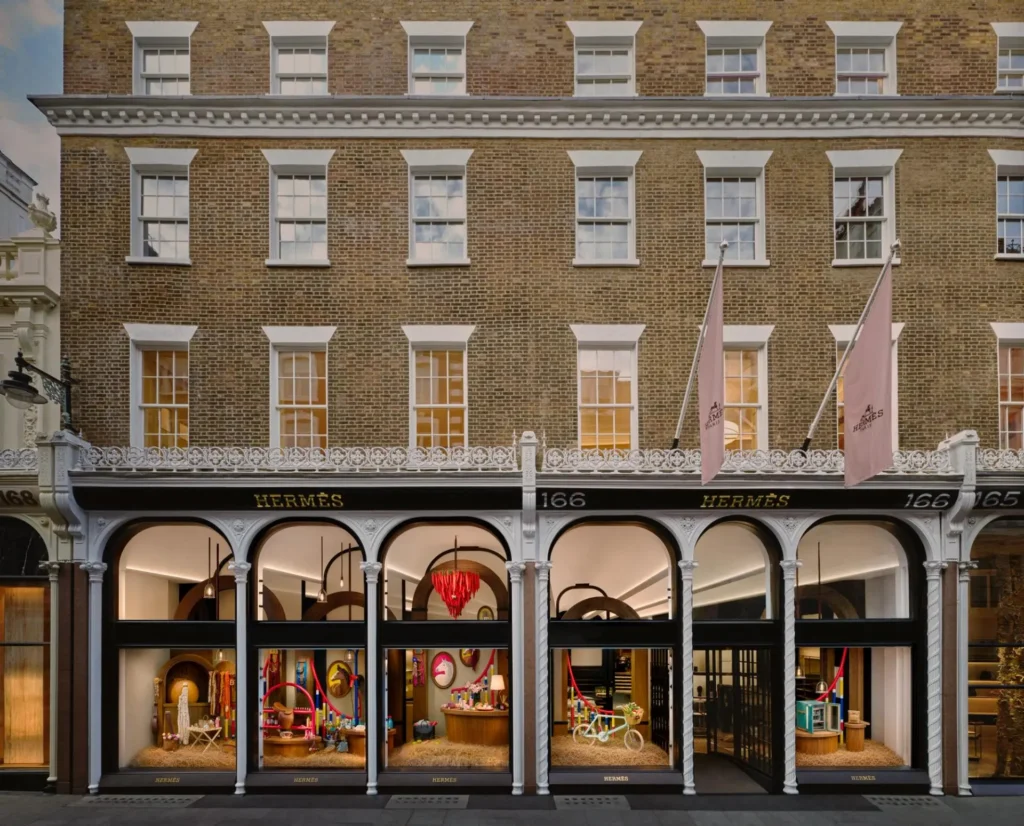
The Maison is Hermès’ fourth London address and its sixth worldwide, joining Paris, New York, Tokyo, Seoul and Shanghai. New Bond Street is one of London’s most concentrated luxury destinations, but rather than inserting another polished retail box into the neighbourhood, Hermès brought together six historic buildings into a complicated architectural footprint that reflects Mayfair itself.
The buildings date from different periods, including Grade II-listed structures, with their original Georgian, Victorian and Edwardian elements retained alongside contemporary work. That mix gives the Maison a sense of accumulated history rather than a manufactured luxury aesthetic.
The timeline says a lot too. Hermès acquired the property in 2009, meaning the journey from purchase to opening stretched across 17 years of restoration and adaptation. Hermès has never been a brand interested in speed for its own sake, and the building seems to carry the same philosophy.
Designed to Get Lost
Most luxury stores are built around immediate orientation: customers walk in, see the collections clearly, and move through an orderly sequence of departments. Hermès went a different way.
The Maison has 55 rooms, several staircases and lifts, terraces, and a dramatic spiral staircase connecting the levels. The spaces vary deliberately. Rather than revealing the whole store at once, the architecture creates a series of smaller encounters: one room feels intimate and residential, another turns theatrical. A change in flooring or wall treatment signals a transition, while artwork and furniture provide diversions along the way.
The visitor isn’t being moved efficiently toward a product. The building wants them to pause, look around, and wonder what’s past the next doorway, a pace that fits a brand built around objects that take extraordinary amounts of time and skill to make.
A French House with a British Accent
Hermès is unmistakably French, but the new Maison isn’t an attempt to reproduce Paris in London. Instead, the interiors set up a conversation between the two cultures. Pierre-Alexis Dumas, Hermès’ artistic director, has described that kind of dialogue as central to how the house approaches a new city, and at 166 New Bond Street it shows through British materials, artists, craftsmen and references sitting alongside Hermès’ own visual language.
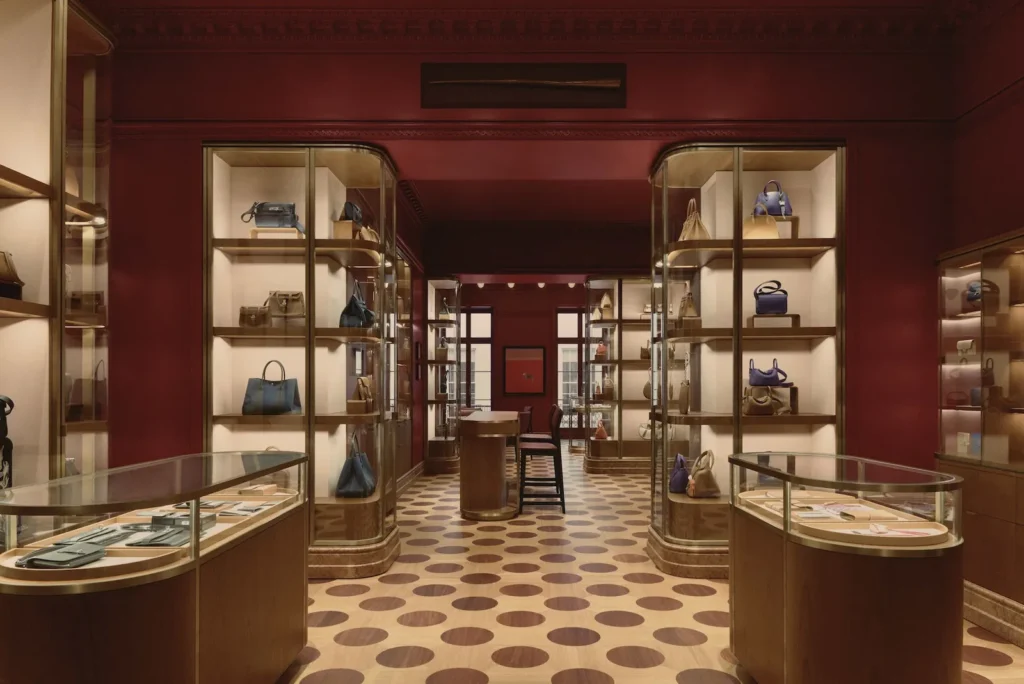
That shows most clearly in the decorative details: straw and horsehair marquetry, textured wall coverings produced in Lancashire, patinated copper, hand-finished surfaces, oak parquet, carpets inspired by British motifs. None of it is overtly themed. There’s no reduction of British identity into predictable symbols. London comes through in craftsmanship and atmosphere instead, which keeps the building connected to its surroundings while staying unmistakably Hermès.
Fifty-Five Rooms, Sixteen Métiers
One of the Maison’s defining features is its breadth. The space brings together all sixteen of Hermès’ métiers, turning the building into a physical map of how much the company actually makes. Handbags might be the most visible part of the business, but the house also works across silk, jewellery, watches, perfume and beauty, home objects, equestrian products, ready-to-wear and other specialist categories. In a conventional store, these would feel like separate departments. Here, each area has its own atmosphere, but the transitions stay fluid, giving the different crafts room to coexist without feeling repetitive, almost like the building itself is a catalogue of Hermès’ creative range.
Art Is Part of the Architecture
The Maison also functions as a serious art environment. More than 500 individual artworks have been chosen for the building, drawn from several Hermès collections and archives, spanning contemporary photography, historical objects, and the house’s own drawings and graphic design material. Art here isn’t decoration placed between product displays. It becomes part of moving through the space.
Two commissioned works stand out. British artist Jessica Wetherly made a life-size rocking horse sculpture on wheels for the atrium, turning a childhood object into an oversized architectural presence, fitting given how deeply the horse is tied to Hermès’ origins in equestrian equipment. Enlarging that familiar object turns the heritage whimsical rather than nostalgic.
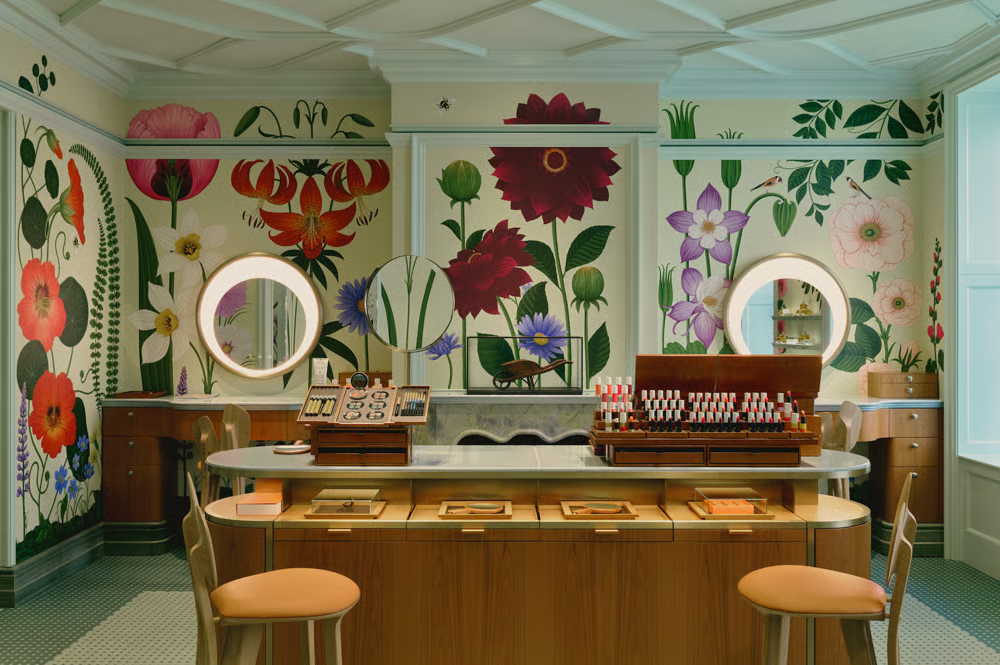
Elsewhere, London-based illustrator Katie Scott created a fantastical work for the perfume and beauty area, built as an imaginary orangerie, adding a more dreamlike note to the Maison and reinforcing the idea that each department should carry its own personality. For all the expense and craftsmanship involved, these touches keep the building from taking itself too seriously.
The Importance of Drawing
Drawing runs through the whole project as a recurring idea. At Hermès, it’s treated as more than a preliminary step in product development. It’s a fundamental creative language, and that shows up throughout the Maison in graphic works and details embedded into the interiors.
One evocative example: a leather panel featuring a scarf design translated into stitching. Rather than just displaying a finished object, the installation shows the relationship between drawing and craftsmanship directly. A pencil makes a line on paper. A craftsman makes another line through stitching. That connection captures something essential about Hermès: the luxury isn’t only in the finished object; it’s in the evidence of the hand that made it, and the new Maison makes that visible.
The Building as a Home
Calling the location a “Maison” is deliberate. The word means house or home, but within Hermès it carries a more specific meaning. The company’s original Paris address on Rue du Faubourg Saint-Honoré set the model for the concept: a place with personality and soul, not just a retail environment.
That explains many of the choices at 166 New Bond Street. The rooms don’t feel identical, because a real home doesn’t have to be. There are intimate spaces and grand ones, formal areas next to playful details, different materials from room to room, with furniture, artwork and colour building distinct atmospheres. The goal isn’t just to impress visitors at the door. It’s to make them curious about what’s further inside.
Luxury Retail Without the Rush
The Maison arrives at an interesting moment for luxury retail. Brands have spent years expanding flagship stores, but scale can work against intimacy, and bigger stores risk feeling corporate when every square metre is optimised for product visibility.
Hermès went the other way. The new address is enormous, but the experience stays deliberately fragmented into smaller encounters, giving visitors room to explore instead of one overwhelming retail floor, which is probably why it feels less like a conventional flagship and more like a private world.
It also reflects a broader shift in luxury. For wealthy shoppers, a physical store increasingly needs to offer something a website can’t replicate. The product is only part of the draw now. Architecture, service, art, craftsmanship and atmosphere are all part of the value, and at 166 New Bond Street, Hermès has made the journey through the store part of the product itself.
A New Landmark for London
There’s a bigger urban story here too. Hermès isn’t just opening another shop in Mayfair. It’s consolidating its London presence into a destination meant to operate at the top level of the house’s global network, replacing the brand’s previous New Bond Street flagship and its presence within Selfridges with one substantial standalone address.
That’s a long-term statement about London, which remains one of the world’s key centres for luxury, culture and international tourism, and where New Bond Street keeps attracting brands competing for the world’s most affluent shoppers. Hermès’ approach leans less on competing through spectacle and more through depth. The spectacle is still there, the scale, the artworks, the architecture, but it’s backed by craftsmanship and storytelling rather than standing alone.
More Than a Flagship
Calling 166 New Bond Street a flagship almost undersells it. A flagship is usually just the largest or most important version of a brand’s stores. Hermès’ new Maison goes further, trying to recreate the character of the house itself inside a building.
Hermès has spent decades building a reputation around objects that resist haste, made through specialist techniques, careful materials and human skill. At 166 New Bond Street, that same philosophy has been applied to space itself. In a city where luxury retail keeps evolving, Hermès responded not by making its London presence faster or more efficient, but by making it more immersive.
Maybe that’s the real luxury of the new Maison: having nowhere else to be.
Written By: Leah Kim
Published On: 28th August 2026