
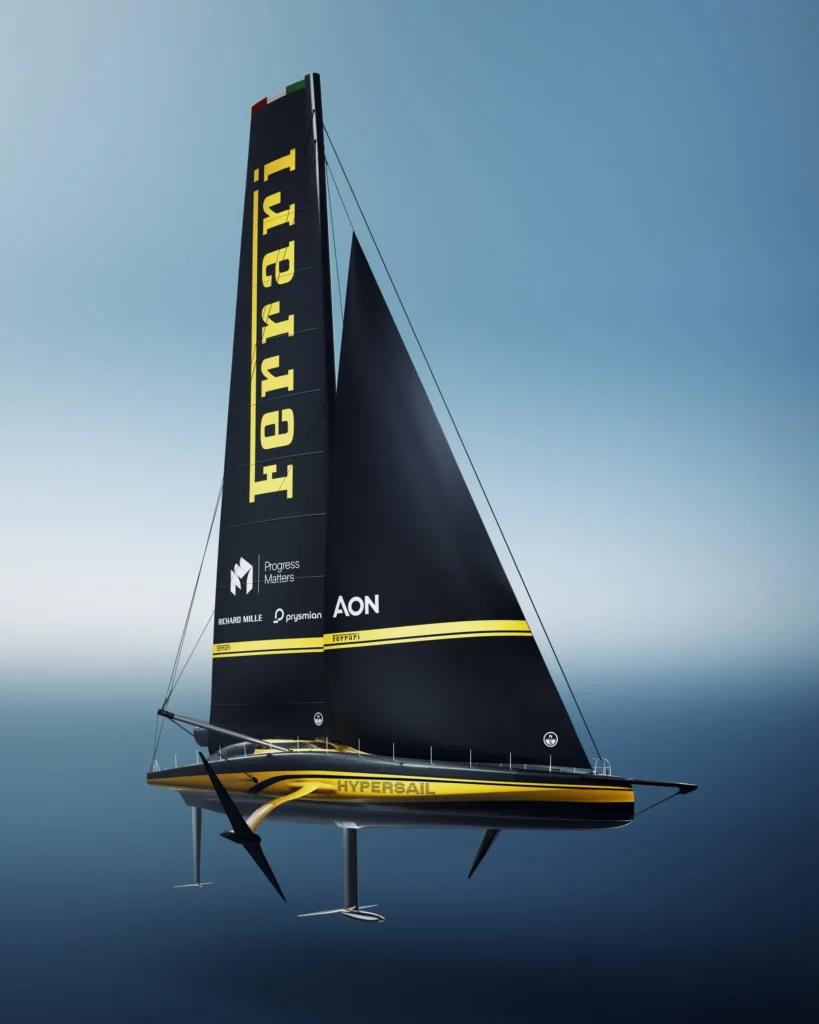
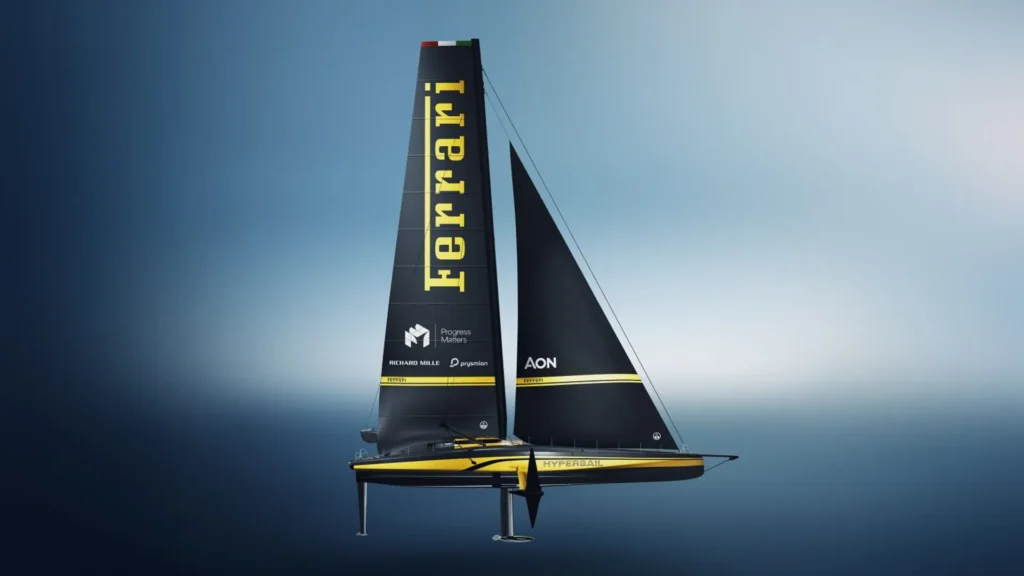
Ferrari is entering competitive sailing with Hypersail, a new offshore racing yacht that transfers many of the engineering principles developed in Formula 1 to the open ocean. For nearly eight decades, Ferrari has built its reputation on pushing the limits of automotive performance. This mindset is translating into this new project, which marks Ferrari’s first major move into sailing. Instead of building a luxury superyacht, the company has focused on a high-performance monohull designed to sail long distances while operating almost entirely without fossil fuels. Renewable energy generated onboard powers the yacht’s systems, while advanced foiling technology and lightweight construction aim to maximise efficiency and speed.
Ferrari considers Hypersail as a development platform as much as a racing yacht. The project will test new materials, energy systems and design solutions under real offshore conditions, where reliability matters just as much as outright performance. Many of those lessons could eventually influence future projects both on the water and back in the automotive world.
Bringing Ferrari Engineering to the Ocean
Although Ferrari has never previously built a sailing yacht, the company’s experience in engineering high-performance machines provides a natural foundation for the project. The same philosophy of continuous innovation through testing and refinement that guides the development of Formula 1 cars translates into the engineering of the Hypersail.
Flying Above the Water
Ferrari is developing Hypersail with a team of naval architects, engineers and offshore sailing specialists, combining the company’s experience in high-performance vehicle design with expertise from the world of ocean racing.
Many of the engineering methods used in Formula 1 carry across to the project. One of Hypersail’s main goals is to operate without the auxiliary diesel engines commonly used to power onboard electrical systems. Instead, the yacht is being designed to generate and store the electricity it needs while at sea, supplying everything from navigation equipment to onboard electronics without relying on fossil fuels.
A Yacht That Generates Its Own Power
Rather than relying on diesel generators to recharge its batteries, the yacht produces electricity from a mix of renewable sources. Solar panels generate power throughout the day, wind turbines contribute when conditions are favourable, and a hydrogeneration system turns the yacht’s movement through the water into electricity while it is underway.
The electricity is stored in onboard batteries and powers navigation equipment, communications, sensors, computers and the control systems needed for offshore racing. Keeping those systems running requires software that constantly monitors how much energy is being produced, stored and consumed. Power availability varies with the weather and sea conditions, so the system must make continuous adjustments throughout a voyage.
Ferrari’s experience with hybrid technology in Formula 1 and its road cars has helped shape that approach to energy management, even though the challenges of offshore sailing are very different from those on a racetrack.
Lightweight Construction for Maximum Efficiency
The yacht is built from advanced composite materials, with extensive use of carbon fibre to keep the structure light while maintaining the strength needed for offshore racing. Keeping the yacht as light as possible improves efficiency in several ways. It can accelerate more quickly, rise onto its foils sooner and use less energy to maintain speed once airborne. Ferrari’s experience with composite manufacturing comes largely from Formula 1, where carbon fibre has been central to car construction for decades. Some of those production methods and engineering techniques are now being adapted for a very different environment on the water.
A Floating Research Laboratory
Ferrari is developing Hypersail as both a racing yacht and a long-term engineering project. Offshore racing gives the company a chance to test new materials, battery systems, sensors and energy management software in conditions that are difficult to recreate in a laboratory. Saltwater, heavy seas, strong winds and constant mechanical stress place every component under pressure, often for days at a time.
That environment can quickly expose weaknesses while also revealing which technologies are capable of withstanding prolonged use at sea. The knowledge gained from Hypersail may also extend beyond sailing. Ferrari expects lessons from the project to inform future research into materials, structural design and energy systems, much as Formula 1 has influenced the company’s engineering work over the years.
Expanding Ferrari Beyond the Road
Hypersail is also Ferrari’s first major project in competitive sailing. The company has expanded into areas such as fashion, hospitality and branded experiences over the years, but those ventures sit outside its engineering operations. Hypersail is different because Ferrari has taken an active role in the yacht’s technical development instead of simply licensing its name.
That involvement places Ferrari alongside naval architects, engineers and offshore sailing specialists working on the project from the ground up.
The move also reflects how engineering disciplines increasingly overlap. Advances in aerodynamics, lightweight materials, computer simulation and energy systems are shared across motorsport, aerospace and high-performance sailing, giving teams in different industries many of the same technical challenges to solve.
Sustainability Without Compromising Performance
Sustainability is one of the central engineering goals behind Hypersail. The yacht has been designed around renewable energy systems that can reduce reliance on fossil fuels while maintaining the performance required for offshore racing. For Ferrari, the challenge is finding ways to make those systems work in an environment where reliability and efficiency are critical.
The project follows a similar direction to Ferrari’s work with hybrid road cars, including models such as the SF90 Stradale, where electric technology is used alongside traditional performance engineering.
Hypersail applies that thinking to a different setting. The team must manage energy generation, storage and consumption across long ocean voyages, where conditions can change constantly, and there is no opportunity for external support. The technologies developed through the project may eventually provide useful lessons for future marine engineering and energy systems.
Redefining the Future of Offshore Racing
Competitive sailing has undergone major technical changes in recent years, with foiling systems, lightweight composites and advanced electronics changing the way racing yachts are designed and operated.
Hypersail brings Ferrari’s engineering experience into that environment, combining knowledge from motorsport with the demands of offshore sailing. The project allows the company to explore areas such as aerodynamics, energy management and materials in a setting where reliability is tested over long periods.
Modern racing yachts already rely heavily on software, simulation and data analysis, much like contemporary motorsport. The challenge for Ferrari is applying those tools to an environment where weather, waves and endurance play a much larger role.
A New Chapter for the Prancing Horse
Hypersail marks Ferrari’s first move into competitive sailing and gives the company a new environment in which to test its engineering approach.
The yacht combines renewable energy systems, foiling technology and advanced composite construction in an effort to improve efficiency without sacrificing performance. Many of the challenges are familiar to Ferrari’s engineers, but the ocean introduces a different set of conditions, from changing weather to long periods of continuous operation.
The project reflects Ferrari’s broader interest in applying its technical knowledge beyond road cars and motorsport. Whether the lessons learned from Hypersail influence future vehicles or remain specific to sailing, the yacht provides Ferrari with a new platform for experimentation.
For now, Hypersail represents an ambitious attempt to bring together two very different forms of high-performance engineering: Formula 1 and offshore racing.
Written By: Leah Kim
Published On: 27th July 2026