
Some jewelled watches use gemstones to make a familiar object feel more expensive. Others seem built around the stones from the start. The RM HJ-02, Richard Mille’s new In-House Automatic Tourbillon, belongs firmly in that second group.
It’s the second chapter in Richard Mille’s high-jewellery run, and it’s trying to fold several disciplines into a single object at once: fine watchmaking, gem-setting, industrial design, and contemporary jewellery. The result is a lot. Each of the 12 watches is a one-off, carrying 1,399 precious and ornamental stones, built around a new skeletonised automatic tourbillon movement called the CRMT2.
What actually matters here isn’t the stone count, though. It’s how those stones were worked into the watch’s architecture. Richard Mille didn’t treat the jewellery as something added after the mechanics were done. It’s one of the core design languages of the piece from the start.
Twelve watches, four worlds
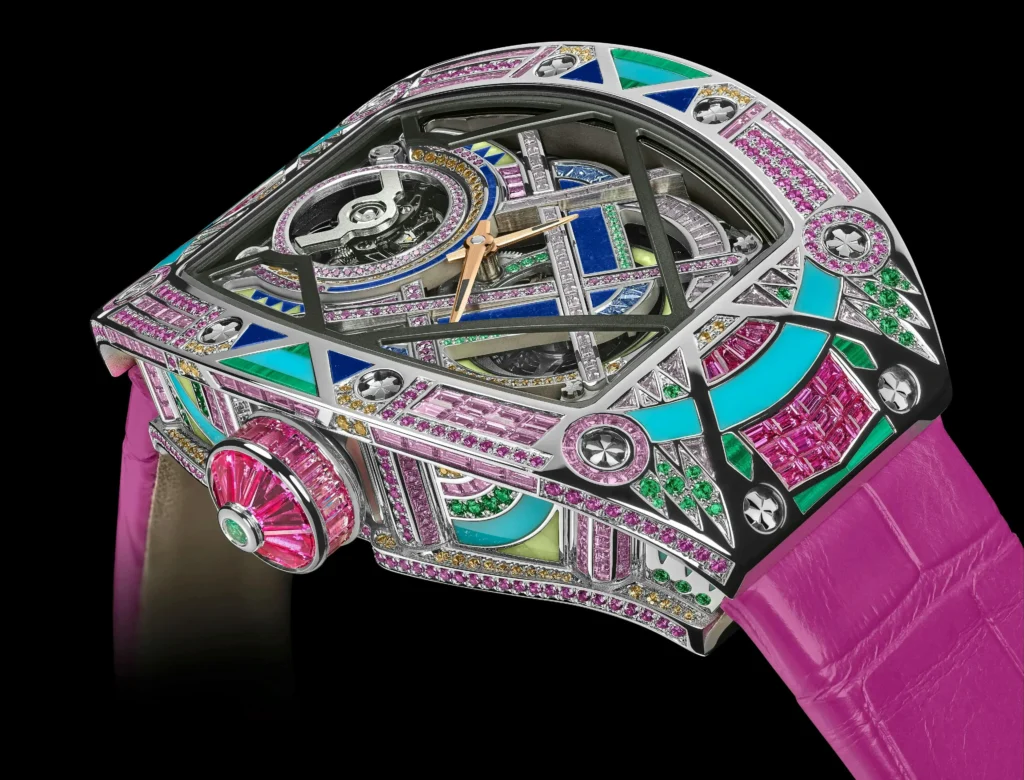
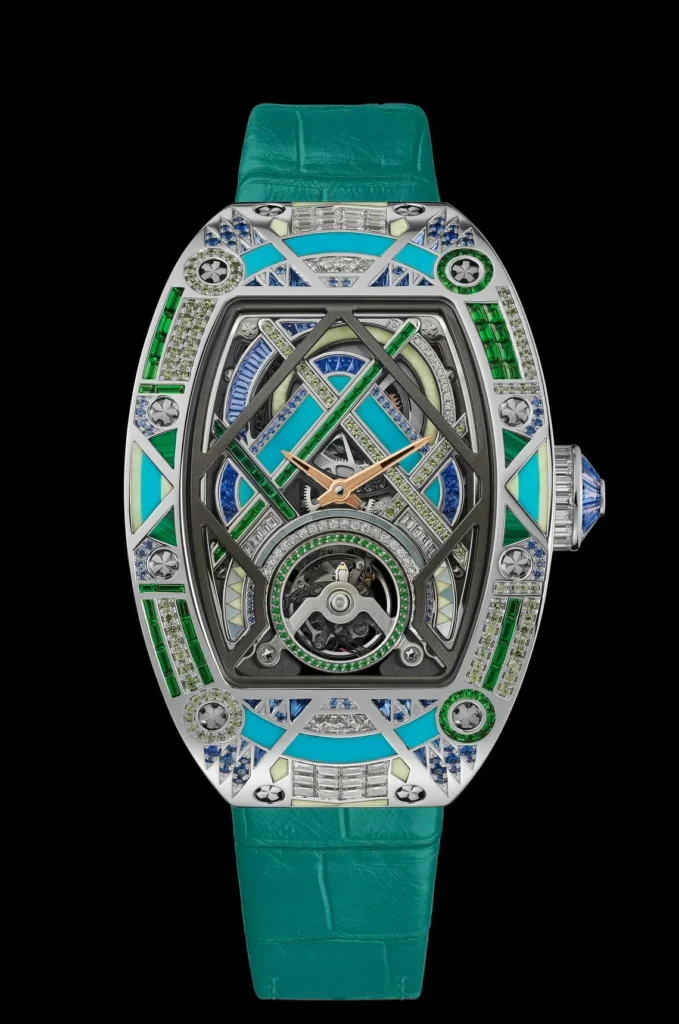
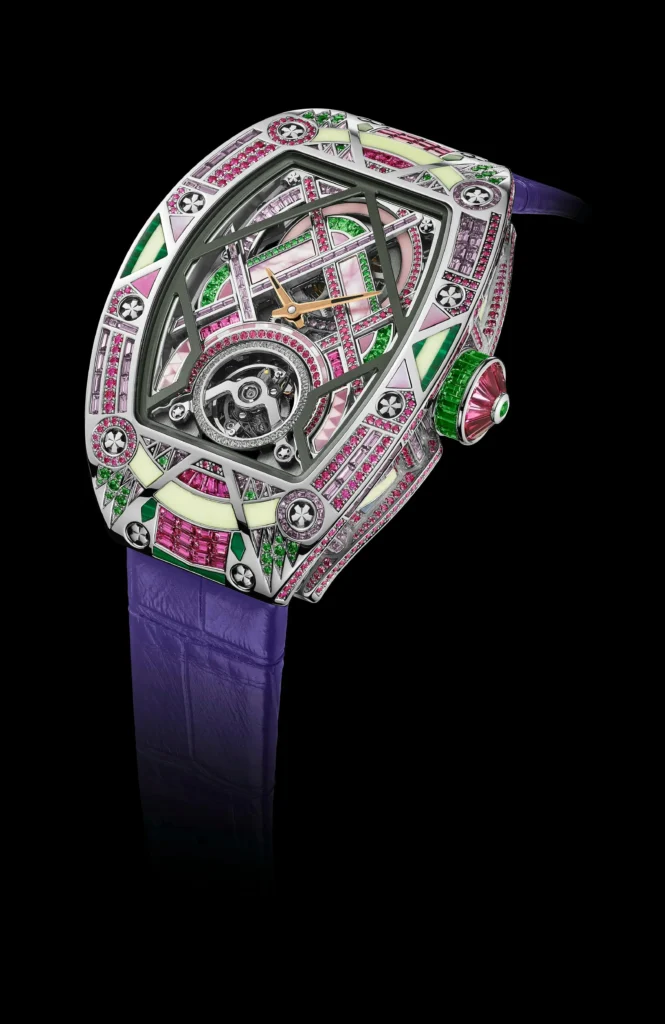
The collection breaks into 12 individual pieces across four colour families: Pink Pursuit, Violet Variations, Blue Ballet and Green Gambit. Instead of building one watch and offering it in different colourways, Richard Mille used colour as the actual starting point for each design.
The stones include the usual high-jewellery names, diamonds, rubies, sapphires, emeralds, but also stretch into turquoise, malachite, chrysoprase and mother-of-pearl. Paraíba tourmalines add sharp flashes of blue and green throughout. This isn’t really about maximising value or rarity. It’s about how colour, transparency, texture and geometry play off each other.
On most gem-set watches, the metal does the structural work and the stones just decorate it. Here, the stones help decide the structure itself. Different shapes and shades get arranged across the case and dial almost like a mosaic, with geometric sections that seem to rise, split apart and reconnect.
It changes as you move your wrist, too. Light passes through the stones, hits polished surfaces, drops into the openworked parts of the movement. What reads as a flat field of colour at first turns into something that keeps shifting.
An Art Deco idea, rebuilt in Richard Mille’s language
There’s real Art Deco influence here, though it’s not a literal reproduction. Richard Mille pulled from the style’s core ideas- geometry, repetition, symmetry, strong architectural lines- and ran them through its own contemporary design language.
The usual tonneau case shape gets broken up. Instead of one smooth curved surface, it’s split by angular transitions, layered planes and asymmetrical sections. That gives the watch a fragmented, almost constructed look, like the case was assembled from individually cut pieces rather than moulded as one shape.
That matters more once you know the case alone reportedly took over a year to develop, with the full watch taking more than three years total. That kind of timeline points to how hard it actually was to make the mechanical, structural and decorative elements work as one thing rather than stacking them on top of each other.
The proportions are still unmistakably Richard Mille. The case runs about 34 by 52mm, giving it real presence on the wrist even with all the decoration going on. It mixes white gold and titanium, with sapphire crystal letting you see into the watch from both sides.
Even the buckle gets the same treatment as the case. It’s gem-set too, so it becomes part of the overall composition rather than an afterthought. The identity of this watch keeps going well past the dial.
1,399 stones, and hundreds of hours of work
The 1,399 stones are the number that grabs attention first. The more telling number, though, is the labour behind it. Richard Mille says nearly 700 hours go into each watch once you count preparation, setting, finishing and the various rounds of quality control. Gem-setting alone eats up a large share of that time.
The jewellers use several setting techniques, including snow, grain, bezel, and they mix stones of different sizes, cuts and colours rather than repeating one pattern across the piece. That’s really where the RM HJ-02 starts to feel closer to high jewellery than typical gem-set watchmaking.
Picking the stones is only step one. Their exact dimensions, how their colours sit next to each other, where they land on a three-dimensional mechanical structure, all of that has to work together. A stone that looks great on its own might not work once it’s placed next to another hue or across a particular curve of the case. The jeweller ends up functioning almost like part of the engineering team. It’s deliberately labour-intensive work, and the value here comes as much from that human effort as from the stones themselves, given how much it took to get nearly 1,400 individual pieces to read as one coherent design.
The mechanics beneath the spectacle
It’d be easy to focus entirely on the jewellery and skip past what’s happening underneath. That would be a mistake. At the centre of the RM HJ-02 sits Richard Mille’s new in-house CRMT2 automatic tourbillon calibre, a skeletonised movement showing hours and minutes with roughly 50 hours of power reserve. It runs at 4Hz with 23 jewels. What matters about the CRMT2 is that it was developed alongside the case and dial, not finished separately and then dropped in. That let the mechanical and jewellery sides of the design get worked out together from the start.
You can see that through the sapphire crystal. The movement is deliberately open, so the tourbillon and other components stay visible. The baseplate and bridges are 18-karat white gold, hand-finished, and they become part of the visual composition rather than just mechanical infrastructure hidden away. Even the automatic rotor is gem-set, which is a bigger deal than it sounds. Rotors are normally purely functional, hidden under the caseback or designed around winding efficiency alone. Here it’s another surface for the jewellers to work on.
The technical side backs this up too. The CRMT2 runs a free-sprung balance with variable inertia, adjusted through weights instead of a standard regulator index, and a fast-rotating barrel meant to keep the mainspring’s torque delivery more consistent. None of the mechanical work here is an excuse for the jewellery, or the other way around. They’re built to function as one object.
Jewellery that refuses to sit quietly
Maybe the most interesting thing about the RM HJ-02 is its attitude toward luxury itself. A lot of high jewellery leans on rarity, proportion and restraint to signal refinement. Richard Mille’s never really worked that way, and the RM HJ-02 pushes that same aggressively modern personality onto gemstones.
There’s no attempt to hide the craftsmanship behind subtlety here. Colour spreads across the whole case. The movement stays exposed. The tourbillon is visible. The stones cover areas that could’ve easily just been left as bare metal. Even the buckle is part of the composition. It ends up feeling less like a traditional jewelled watch and more like a piece of wearable sculpture.
It also says something about how some of the more experimental names in watchmaking are rethinking women’s watches. Richard Mille frames this collection as marking 20 years of designing watches for women, and the RM HJ-02 leans into individuality rather than a conventional idea of femininity. The campaign around it, including appearances from longtime Richard Mille collaborator Michelle Yeoh, backs that up. These watches aren’t pitched as accessories. They’re pitched as personality, colour, independence.
Beyond the diamond-set watch
The real question the RM HJ-02 raises has less to do with whether you like how extravagant it looks and more to do with what happens once a watchmaker stops treating jewellery and mechanics as separate jobs. Richard Mille’s answer here is to make that line almost impossible to find.
The whole object reads as one exercise in colour, structure and mechanical movement, which is exactly why it feels different from a typical high-jewellery watch despite much of the materials being familiar.
It’s not extravagant just because there are more stones on it. It’s extravagant because of what those stones are allowed to do. Twelve unique pieces, four colour families, more than three years of development, this clearly sits in an extremely narrow corner of the watch market. Price is available on request only, and production is capped at those 12 pieces.
But the scarcity is almost beside the point. The RM HJ-02 makes the case that high jewellery can be structural, mechanical and genuinely modern without giving up the craft that defines good gem-setting. It flips the usual question around. Instead of asking how many stones you can fit onto a watch, it asks what the watch becomes if the stones help define what it is from the very beginning.
That’s really the achievement here. It’s not just a tourbillon covered in gems, and it’s not just a piece of jewellery that happens to tell time. It’s an attempt to make the mechanical and the decorative genuinely inseparable, a small, complicated object where colour, craft, engineering and movement all share the same space. For a brand that’s built its whole identity on ignoring convention, maybe the most fitting thing about the RM HJ-02 is that it won’t pick a side between watch and jewellery.
Written By: Leah Kim
Published On: 10th August 2026