
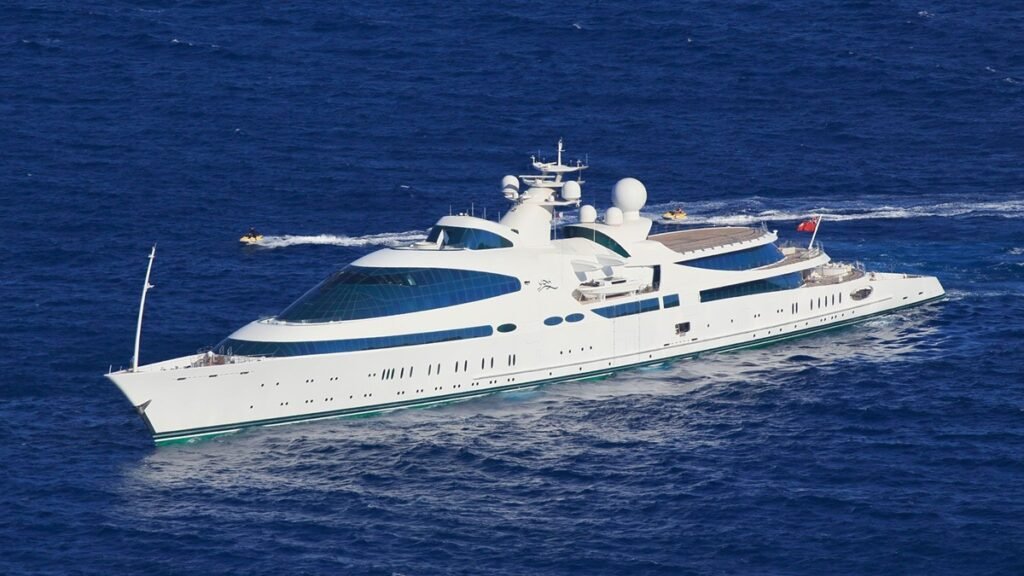
Few superyachts attract attention as effortlessly as Yas. At 141 metres long, with a narrow hull, huge expanses of glass and a futuristic silhouette that looks more at home in a science-fiction film than a Mediterranean harbour, the vessel is impossible to mistake for anything else.
That profile used to look very different. Yas began life not as a luxury yacht but as a Dutch naval frigate. Decades later, the former warship has become one of the world’s most recognisable private superyachts, mixing military-grade origins with an interior built for extreme luxury.
The yacht drew fresh attention in Greece after appearing in Nafplio in August 2026. According to recent reports, Yas belongs to Sheikh Hamdan bin Zayed bin Sultan Al Nahyan, a senior member of Abu Dhabi’s ruling Al Nahyan family, and its arrival in the historic Peloponnese port put the vessel against one of Greece’s most picturesque waterfronts.
From Dutch warship to private yacht
Yas started life in the Dutch Royal Navy. The vessel launched in the Netherlands as HNLMS Piet Hein, a Kortenaer-class frigate built by Koninklijke Schelde. Sources differ slightly on the exact launch date and dimensions, but her naval career is well documented: she served the Royal Netherlands Navy for more than two decades before being transferred to the United Arab Emirates.
In UAE service, the vessel was renamed Al Emarat and kept operating as a military ship into the mid-2000s. It was then acquired for conversion into a private yacht, with the transformation taking place in Abu Dhabi under the working name Swift 141, eventually emerging as Yas after an extraordinary reconstruction.
The scale of the project turned out to be far bigger than planned. According to BOAT International, most of the hull needed rebuilding, which ended up giving the designers a chance to fundamentally rethink the vessel’s appearance and interior rather than just refit it.
A design unlike anything else
Pierrejean Design Studio led the transformation, and it’s what gave Yas its unmistakable character. Designer Jacques Pierrejean drew on nature for the shape, particularly the streamlined form of a dolphin or porpoise. The finished yacht keeps the narrow, purposeful proportions of its frigate heritage but swaps the visual language of a warship for flowing surfaces, a sculpted superstructure and huge areas of glass.
The standout feature is the glass-fronted structure toward the bow, housing both the bridge and the owner’s suite. It creates a striking visual connection between the interior and the sea. Instead of tucking the command centre inside a conventional enclosed superstructure, the design turns it into the yacht’s most prominent architectural statement.
The dark glass against the white exterior gives Yas the look of something built for speed rather than leisurely cruising, and that’s partly true to its history. Frigates are built around efficient, relatively narrow hulls capable of moving quickly and manoeuvring well, qualities that translated surprisingly well into the superyacht world.
The extraordinary scale of Yas
Yas measures roughly 141 metres with a beam of about 15 metres. BOAT International lists it at 5,002 gross tonnes, with room for up to 60 guests and 56 crew, figures that put it firmly in the upper tier of the world’s superyacht fleet. That scale is even more striking given what the ship was originally built for. A naval frigate is designed around operational requirements, not private hospitality, so turning that utilitarian foundation into a floating residence for dozens of guests and a large professional crew was no small feat. The yacht also moves fast for its size. BOAT International lists a top speed of 26 knots, and other yacht databases put it in a similar mid-20-knot range, consistent with the streamlined hull built into its original design.
A military hull with a luxury heart
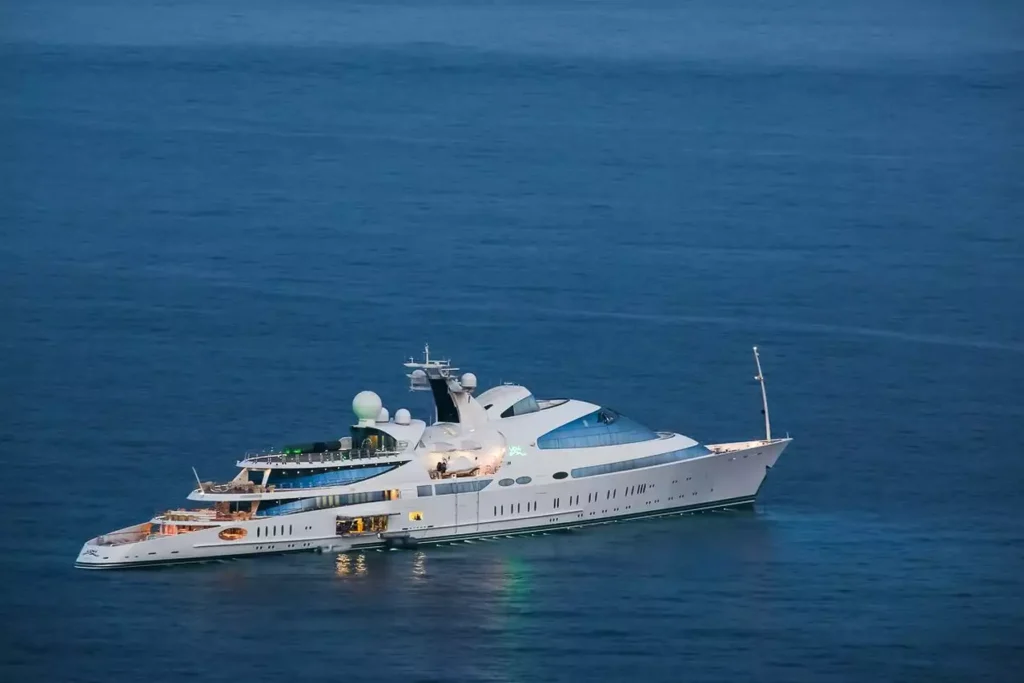
Part of what makes Yas fascinating is the contrast between its exterior and its purpose. The steel hull and naval proportions are reminders of its past, but the atmosphere inside is meant to feel completely different. Pierrejean Design Studio handled both the exterior and interior, building out expansive accommodation and entertainment spaces, with the leisure facilities you’d expect on a yacht of this scale: a swimming pool, spa, gym, cinema and a helipad.
The aft section stands out in particular. During reconstruction, the yacht was lengthened by roughly 12 metres, opening up space at the stern for a substantial outdoor pool area. BOAT International notes the pool includes a waterfall, giving a resort-like feel to a space that once belonged to a military vessel.
The glass dome that defines the yacht
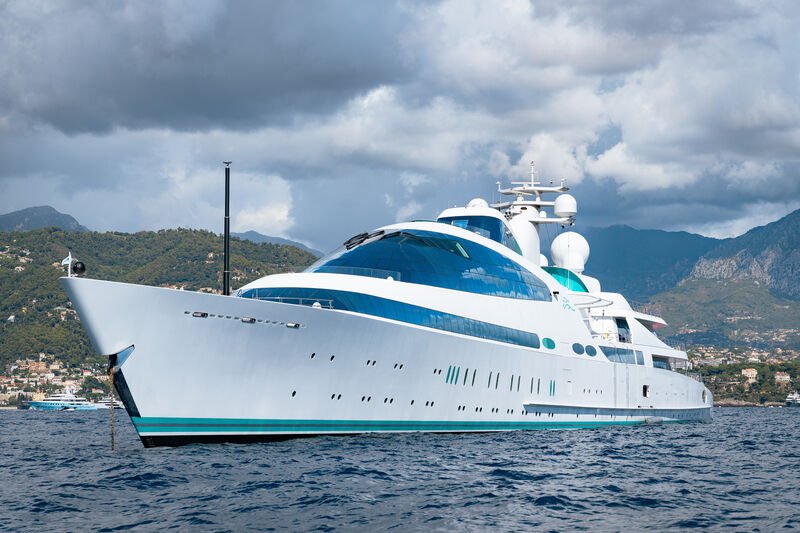
Most superyachts get recognised for their size. Yas gets recognised for one architectural gesture: the huge glazed structure at the front that gives it a distinctive face. The curved glass creates an almost panoramic enclosure around the bridge and owner’s accommodation while letting natural light reach deep into the upper levels, reinforcing the yacht’s connection to the sea.
Pierrejean’s approach worked from the idea that changing the exterior would inevitably change the interior. By replacing conventional superstructure with extensive glazing, the design created interiors that feel dramatically more open to their surroundings.
Why the conversion is so unusual
Converting an existing vessel into a luxury yacht isn’t unheard of. Former commercial ships, research vessels and military vessels have all been repurposed for private use. Yas belongs to a rarer category, though. The challenge wasn’t simply renovating an old ship. It was preserving enough of the original naval structure to make the project viable while fundamentally changing its character, which meant extending the hull, rebuilding significant sections, replacing major machinery and building an entirely new superstructure.
The project also took years. The rebuilt hull launched in the early 2010s, with completion and interior outfitting continuing before the yacht was delivered and started appearing in the Mediterranean. BOAT International puts the major reconstruction phase to completion at around four years, a timeline that makes sense given the ambition: Yas was essentially being built twice, once as a naval vessel and once as a private yacht.
A yacht that refuses to blend in
The narrow hull, enormous forward glazing and dolphin-inspired profile make Yas one of the few yachts identifiable almost instantly from photographs. BOAT International calls it one of the rare vessels that genuinely earns the word “unique,” which matters in the Mediterranean, where some of the world’s most spectacular yachts gather every summer. When it appeared in Nafplio, its scale and futuristic look stood out sharply against the town’s historic waterfront. Greek City Times reported that the vessel drew attention from locals and visitors, and identified Sheikh Hamdan bin Zayed as its owner.
The mystery surrounding its owner
Yas has long carried an aura of privacy. It’s associated with Sheikh Hamdan bin Zayed bin Sultan Al Nahyan, a senior member of Abu Dhabi’s ruling family, and recent reporting has linked its presence in the Nafplio region to the wider activities of UAE royal family members in the Argolid. As with most privately owned superyachts, though, details about how and when it’s actually used stay limited.
That discretion is part of the culture around vessels this size. A superyacht is ultimately a private residence at sea, and privacy is one of its most valuable features, letting an owner travel between countries without relying on hotels, resorts or public infrastructure, backed by a support team capable of handling everything from navigation to hospitality.
A floating palace with a warship’s DNA
“Floating palace” gets applied to a lot of huge yachts, but Yas actually earns it, and not by forgetting where it started. The luxury comes from the contrast. Beneath the polished surfaces is a ship built for naval service. The narrow hull that once supported a frigate now carries a private yacht for 60 guests. The military superstructure is gone, replaced by flowing lines and a vast glass pavilion. A former operational vessel now has a pool, spa, cinema and luxury accommodation.
Why Yas remains an icon
Superyachts can go stale fast. Design trends shift, new vessels get longer, technology moves on, and a yacht that looks revolutionary one year can look conventional a decade later. Yas has avoided that.
Today, Yas stands as one of the most unusual vessels in the superyacht fleet, not because it’s the largest, newest or most extravagant afloat, but because almost nothing else combines naval heritage, extreme scale and avant-garde design quite the same way. When it enters a harbour, people look.
And when it eventually leaves, the most memorable thing about Yas probably isn’t its reported $180 million value or its specifications. It’s that beneath one of the world’s most futuristic superyachts sits the skeleton of a warship that once sailed under a completely different flag, built for an entirely different purpose, and became an entirely new chapter in its own life.
Written By: Leah Kim
Published On: 24th August 2026