
The business aviation market is ever-evolving, with new luxuries enabling manufacturers to develop jets with greater efficiency, safety and sophisticated cabin experiences. In this contemporary landscape, Embraer has introduced the Phenom 300EV, the latest evolution of its highly successful light jet family. Embraer has consistently dominated the light jet segment for over a decade, honing its craft to build upon its established foundation while implementing continuous improvements. Ultimately, the Phenom 300EV thus reflects how executive aviation is adapting to modern expectations of luxury.

Building on an Industry Benchmark
Since entering the market, the Phenom 300 series has earned a reputation for impressive speed, reliability and operating economics. Because of this, the jet’s versatility helped it become renowned amongst various groups, including private owners and charter operators. As reflected by its continued commercial success, the Phenom 300 has effectively positioned itself as one of the most recognisable aircraft in the light jet market.
Though maintaining leadership in this competitive market segment requires continual innovation. Consequently, the Phenom 300EV demonstrates Embraer’s proactive innovative strategy that understands the need to evolve. Rather than creating an all-new product, they have improved their already established aircraft, retaining the characteristics already familiar to consumers while integrating new improved technologies. In doing so, the Phenom 300EV possesses improvements in safety automation, digital flight management and operational efficiency.
Enhanced Performance Without Reinventing the Aircraft
One of the main defining characteristics of the new model is its performance. The Phenom 300EV introduced improvements in several aspects of the aircraft, offering increased operational flexibility while maintaining the qualities already appreciated by pilots. This aircraft remains one of the fastest in its category, enabling passengers to complete regional and mid-range business trips efficiently. Consequently, its performance, particularly its short runway capability, allows access to a wide range of airports that larger business jets cannot easily use. This feature is regarded as one of the Phenom family’s strongest features, as business travellers frequently desire direct access to smaller airports local to their final destination to reduce travel time. Improvements in the Phenom 300EV included climb performance, operational efficiency, and overall capability, making the jet desirable for multi-use.
A New Generation of Flight Deck Technology
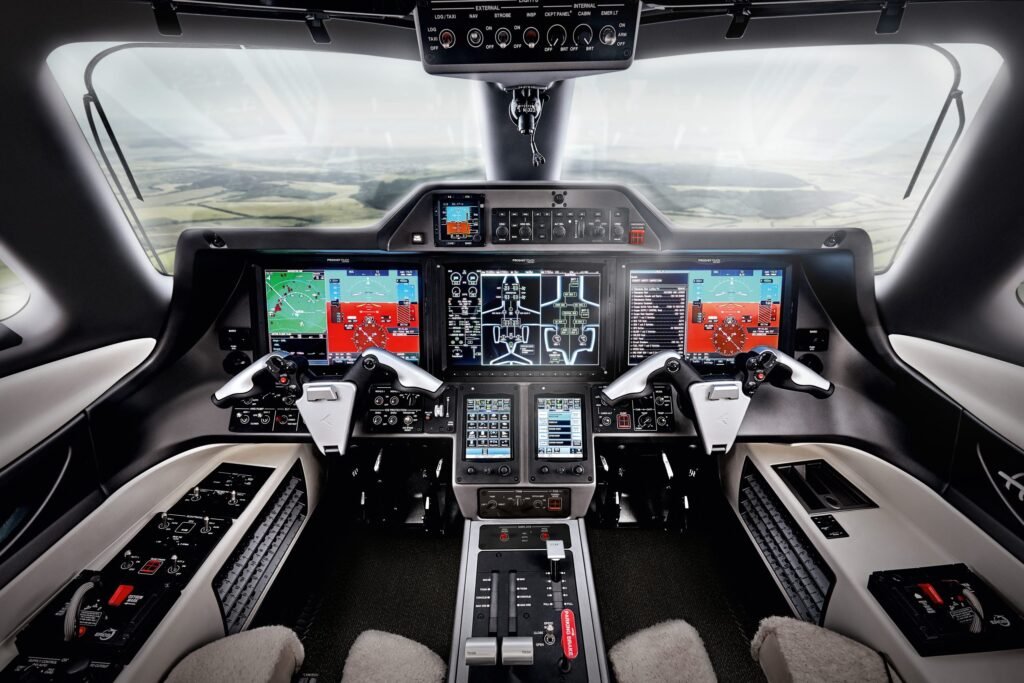
Additionally, one of the most significant upgrades in the Phenom 300EV is its updated avionics suite. Modern business aviation has increasingly provided intelligent cockpit systems that assist pilot workload. Embraer has embraced this new technology by incorporating the latest generation of Garmin flight deck technology into the aircraft. In doing so, the upgraded cockpit offers improved data presentation, enhanced navigation capabilities, and more seamless integration between various aircraft systems. Furthermore, advanced flight planning tools and enhanced weather visualisation enable more informed decision-making throughout each phase of flight, increasing safety and experience. These improvements are especially valuable during critical situations, where rapid access to accurate information becomes essential.
Automatic Emergency Landing Adds a New Layer of Safety
Should the pilot become incapacitated during flight, passengers can activate the emergency landing system with a dedicated control. Once engaged, the aircraft automatically determines a suitable airport, communicates with air traffic control, navigates to the destination, performs the approach, lands, and brings the aircraft safely to a stop.
Safety is further emphasised through the inclusion of Garmin’s automatic emergency landing capability. This new technology represents one of the most significant safety modern innovations introduced to business aviation. In a demanding situation where the pilot is unable to land the flight, passengers can activate the emergency landing system. Once engaged, the aircraft will automatically determine a suitable airport, communicate with air traffic control, navigate to the destination, perform the approach, land, and bring the aircraft safely to a stop.
Throughout this entire process, the system will additionally manage to continuously monitor weather conditions, fuel, terrain, runway suitability and nearby traffic. This feature adds reassurance to passengers, as even without aviation experience, they are able to receive a layer of protection and security in the event of an emergency.
Smarter Automation Reduces Pilot Workload
Business aviation missions often involve busy schedules, unfamiliar airports, and varying weather conditions. Intelligent automation helps pilots manage these complexities more efficiently. In addition to safety improvements, the updated aircraft introduces an improved avionics package that helps simplify everyday flying. Frequent business aviation can involve hectic schedules, with unfamiliar airports and changing weather conditions. The introduction of automation, such as continuously monitored flight parameters, predictive alerts, and navigation assistance, helps pilots manage airborne complexities. Though, to note, these additions do not replace pilot judgment, instead helping to reduce pilot workload and allow crews to focus on strategic decision-making.

Passenger Comfort Remains a Priority
Moving beyond the pilot and aircraft capabilities, the passenger experience and quality itself is improved upon. The Phenom 300EV continues Embraer’s emphasis on creating an environment suited to productive business travel while also supporting relaxation. The aircraft features a spacious cabin with comfortable seating and carefully designed interiors. The presence of large windows enables natural light to seep into the cabin. Focus on noise reduction also creates a quieter passenger experience, supporting conversation, work or rest while flying. For corporate flights, these improvements help transform travel time into productive working time, increasing appeal for business aviation.

Operational Flexibility Drives Market Appeal
A large contributor to the Phenom family’s success is its operational flexibility. Unlike larger jets that are designed primarily for long-haul missions, these light jets are often able to complete multiple flights within one day. This places significant importance on fuel efficiency and turnaround times and increases value amongst busy passengers. The Phenom 300EV addresses these priorities while maintaining competitive performance. Operators are able to benefit from reduced operating costs compared to other mid-sized aircraft while enjoying impressive cruise speeds and experiences. The ability to efficiently serve across short and medium-length trips broadens its appeal across numerous customer segments, making it attractive for regional business travel, charter services, medical transport, and executive corporate fleets.
A Competitive Market Continues to Evolve
With increased technology, the light jet segment has become increasingly competitive. Purchase decisions involve factors beyond speed and range, frequently including a multitude of factors, some including avionics sophistication and passenger experience. Consequently, by introducing meaningful upgrades without fundamentally altering the already successful Phenom 300, Embraer has focused on practical innovation that directly benefits operators.
Written By: Leah Kim
Published On: 17th July 2026