
Ralph Lauren has spent decades constructing a recognisable vision of American style: collegiate tailoring, Western references, equestrian codes, denim, country houses. But its latest collaboration looks beyond those familiar signifiers, turning instead to a community whose history has been stitched into fabric for generations.
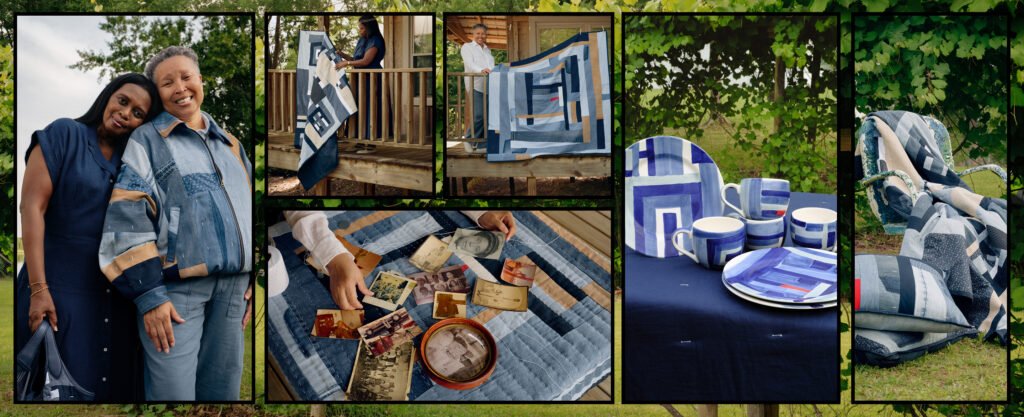
The Ralph Lauren x Gee’s Bend collection, launched in July 2026 as the fifth collaboration in the brand’s Artist in Residence programme, brings the work of Alabama textile artists Claudia Pettway Charley and Loretta Pettway Bennett into a limited-edition collection of fashion and homeware. Rather than simply borrowing the visual language of Gee’s Bend quilting, the project is structured as a collaboration with two artists whose families have carried the tradition forward across generations.
Gee’s Bend quilting is not a passing aesthetic trend or a decorative style waiting to be rediscovered. In Ralph Lauren’s latest project, that history becomes the starting point for a conversation between luxury fashion and one of America’s most distinctive textile practices.
A tradition built from necessity
Gee’s Bend, also known as Boykin, is a small, historically Black community in Alabama’s Black Belt, surrounded on three sides by the Alabama River. Its quilting tradition developed over generations, with women creating functional textiles from materials that were available to them, including worn clothing, denim and other remnants.
What began in circumstances where resourcefulness was essential eventually developed into an extraordinary visual language. Gee’s Bend quilts are celebrated for their irregular geometry, unexpected colour combinations, rhythmic lines and refusal to conform to conventional ideas of symmetry. Their power often lies precisely in their imperfections: a composition can feel spontaneous while remaining intensely considered.
The tradition has subsequently moved far beyond its original domestic setting. Gee’s Bend quilts have entered the world of museums and contemporary art, helping to challenge the old distinction between “craft” and “fine art”. Ralph Lauren’s own description of the community recognises quilting as an American art form whose makers have transformed found materials into functional works with artistic and narrative significance.
Two artists, two distinctive voices
At the heart of the project are Claudia Pettway Charley and Loretta Pettway Bennett. Pettway Charley is a fourth-generation textile artist whose work is known for an intuitive, improvisational approach to colour and composition. Pettway Bennett, a fifth-generation artist, is recognised for graphic quilts in which pattern and personal history are closely connected.
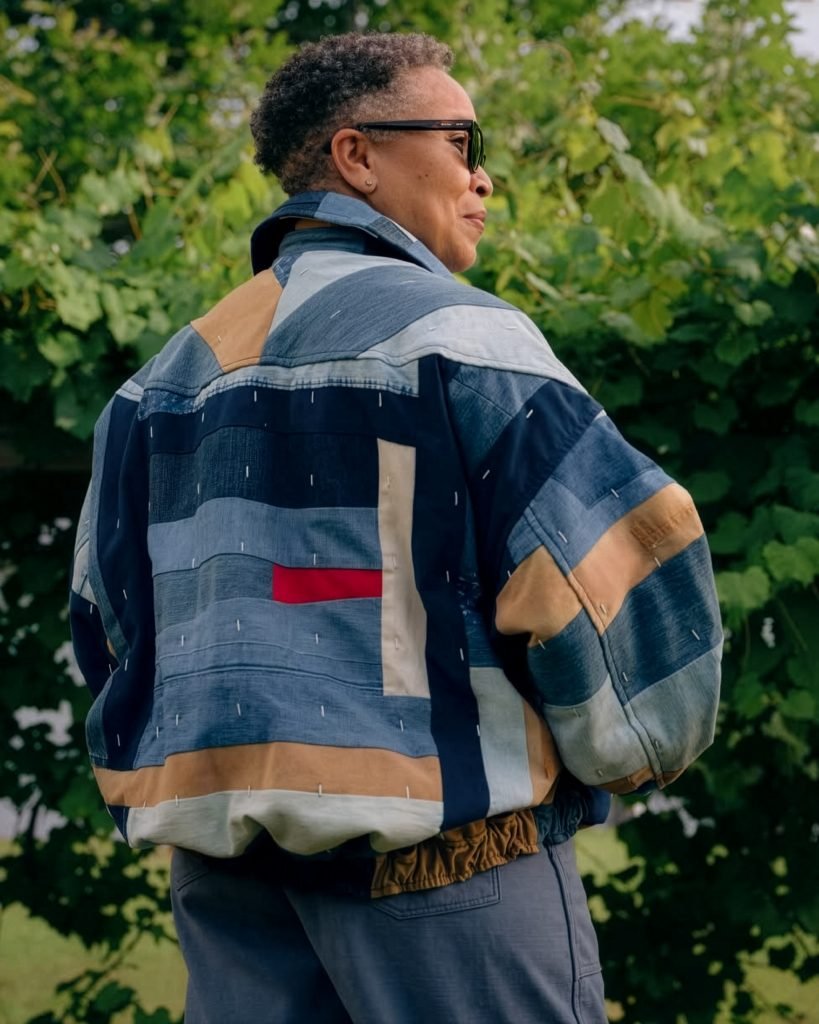
One particularly striking example is Pettway Bennett’s use of recurring red triangles. Within her work, the motif carries personal meaning, representing her sons. In the Ralph Lauren collection, details such as this transform what might otherwise look like a purely graphic design decision into something more intimate.
Pettway Charley’s contribution similarly centres on instinctive decisions around colour and composition. Together, the two artists demonstrate the range within Gee’s Bend quilting rather than presenting it as a single, uniform style.
From quilt to wardrobe
The most obvious challenge for Ralph Lauren was translating a highly tactile, handmade art form into contemporary luxury fashion without stripping away what makes it distinctive. The collection incorporates hand-pieced elements, visible stitching, freeform lines and geometric blocks. Upcycled Ralph Lauren fabrics have been incorporated into the pieces, echoing the historic Gee’s Bend practice of transforming existing materials into something new.
Denim plays a particularly important role. For Ralph Lauren, denim is already embedded in the brand’s vocabulary of American workwear and Western-inspired dressing. For Gee’s Bend quilters, workwear fabrics have a different but complementary history, having long been valued for their durability and availability. Denim is not simply fashionable here; it provides a bridge between two different interpretations of American identity.
The result includes apparel and accessories, with a hand-pieced jacket among the collection’s standout pieces. Artnet reported the jacket at US$4,998, while other pieces include quilts and the Polo Play Bag. Rather than concealing the labour involved, the collection makes construction part of the aesthetic. Stitching is visible. Panels retain their individuality. Lines do not always behave as they would in mass-produced geometric design.
The home enters the picture
The collaboration extends beyond clothing into interiors, creating a broader expression of the Gee’s Bend aesthetic. Among the pieces are decorative pillows, quilts and hand-painted ceramic tableware. The ceramics were produced in Italy with Ralph Lauren Home’s artisan partners and designed with softly glazed surfaces and deliberate asymmetry.
By translating the visual and tactile qualities of Gee’s Bend into objects for the home, Ralph Lauren acknowledges that the tradition cannot be reduced to clothing alone.
The ceramics, meanwhile, provide an intriguing counterpoint to the textiles. They are not quilts translated literally into another material. Instead, their irregular forms and handmade appearance evoke the same sense of human intervention.
Beyond inspiration
Perhaps the most consequential aspect of the project is not what the collection looks like, but how Ralph Lauren says it was developed. The collaboration sits within the company’s broader “Design With Intent” initiative, which seeks to move Ralph Lauren’s approach to American heritage from inspiration towards direct collaboration with communities that have historically influenced its creative work. Luxury brands have long drawn on cultural traditions from around the world. But there is a fundamental difference between taking visual inspiration from a community and working directly with the people who sustain its traditions.
Ralph Lauren describes its Artist in Residence programme as an immersive exchange between artisans and the company’s creative teams. Gee’s Bend is the fifth collaboration under the initiative, following work with Diné/Navajo artist Naiomi Glasses, Zefren-M, Jocy and Trae Little Sky of TÓPA, and another collaboration involving Glasses and her brother Tyler. For a brand whose identity has traditionally centred on a particular, highly polished vision of America, that expansion is significant.
History cannot be separated from the art
The story of Gee’s Bend is also inseparable from the wider history of Black life in the American South. The community experienced the effects of racial segregation and discrimination, and its history intersects with the civil rights movement. The Freedom Quilting Bee, established in 1966, became an important cooperative through which local quiltmakers could work collectively and generate income from their craft.
This is why the Ralph Lauren collaboration works best when viewed as an encounter between histories rather than simply a meeting of patterns. The Ralph Lauren side brings its own material vocabulary, particularly denim, tailoring and luxury production, while the Gee’s Bend artists bring a visual and cultural tradition that developed under very different circumstances.
Craft as contemporary luxury
There is also something revealing about the collaboration’s timing. Luxury fashion has increasingly returned to the value of making: handwork, artisanal production, limited quantities, provenance and objects that reveal the human effort behind them. Gee’s Bend fits naturally into that conversation, but it also complicates it.
The community’s quilts were not originally created as luxury goods. They emerged from practical needs and available materials. Their elevation into the art world happened later. Ralph Lauren now places that tradition inside a luxury framework, where a handmade jacket can command thousands of dollars and a textile composition can become an object of fashion and collecting.
That transformation raises complicated questions about value. Who determines when craft becomes art? What happens when an object born from necessity enters the luxury market? And can a major global brand help broaden recognition of a tradition without reducing it to a trend? The structure of the collaboration offers one possible answer: give the artists authorship, retain the handmade character of the work, acknowledge its history and direct some of the commercial value back towards the community.
A contribution beyond the collection
The project also includes a philanthropic component. Ralph Lauren has committed five per cent of the purchase price of each item in the collection to the Equal Justice Initiative, the Montgomery-based organisation focused on racial justice and equality. According to Ralph Lauren, the proceeds will support EJI’s hunger-relief programming and assistance for low-income families across Alabama.
That element adds another layer to the collaboration’s relationship with Alabama. It also connects commercial activity with an organisation working on social issues in the same state where the quilting tradition developed.
Redefining an American fashion vocabulary
Ralph Lauren has always been interested in storytelling through clothing. What changes with Gee’s Bend is whose stories are being placed at the centre of that narrative.
For decades, the brand’s version of America has been remarkably coherent. The new collection introduces another America, one expressed through Black history, rural community, improvisation, resourcefulness and textile memory.
The collaboration does not attempt to make the quilting tradition look more polished or conventional. Instead, it allows irregularity, colour, repetition and visible handwork to remain visible.
In doing so, it makes a case for a different kind of luxury: one in which provenance matters as much as finish, where the maker is as important as the label, and where an object can carry a history that existed long before it entered a fashion collection.
The Ralph Lauren x Gee’s Bend release became available in North America on July 28, 2026, followed by its global launch on July 30 through Ralph Lauren’s website and selected stores.
Written By: Leah Kim
Published On: 17th August 206