
Mercedes-Maybach has never been about making the S-Class simply more expensive. The Maybach formula takes an already prestigious limousine and pushes it further into comfort, craftsmanship and exclusivity, while keeping the engineering sophistication Mercedes-Benz is known for.
For 2027, though, the Mercedes-Maybach S-Class is taking a slightly different approach in Australia. The facelifted range introduces a new V8-powered S580 beneath the existing S680 flagship, giving Australian buyers a cheaper way into the Maybach nameplate without giving up what defines the brand. Priced from $517,900 before on-road costs, the S580 sits $64,528 below the V12-powered S680, which itself rises to $582,428.
That makes the S580 more than another engine choice. It shifts how the Maybach S-Class is positioned in Australia, widening the gap between the conventional Mercedes-Benz S-Class and the ultra-luxury Maybach range, and giving customers a real choice between two very different takes on flagship performance. The updated Maybach is expected to reach Australian showrooms in the first quarter of 2027.
A More Accessible Maybach
Until now, Australian buyers wanting a Mercedes-Maybach S-Class had effectively been pushed toward the V12-powered S680. The new S580 changes that by pairing a 4.0-litre twin-turbocharged V8 with Mercedes-Benz’s latest mild-hybrid technology.
The engine produces 395kW and 750Nm, with a 17kW electric motor built into the 48-volt electrical system providing extra assistance. Those figures put the S580 firmly into performance-car territory, even though its main job is moving passengers in exceptional comfort.
Its claimed 0-100km/h time is 4.5 seconds, identical to the S680 in Australian specification. That’s a telling detail: choosing the cheaper Maybach doesn’t mean accepting a dramatically slower car. The S680 keeps its 6.0-litre twin-turbocharged V12, producing 463kW and 900Nm, but the extra cylinders and higher output don’t translate into a quicker official acceleration figure.
For many buyers, the decision becomes less about outright speed and more about what the engine represents. The S580 is the modern, technologically updated V8 take on Maybach luxury. The S680 stays the statement piece, the V12 flagship for customers who want one of the most prestigious powertrains still available in a large luxury sedan.
The New Generation of Mercedes V8
The S580’s engine matters beyond the Maybach itself. Known as the M177 Evo, the 4.0-litre twin-turbocharged V8 is part of Mercedes-Benz’s broader push to keep high-cylinder-count petrol engines viable under increasingly tight regulation.
The engine uses a flat-plane crankshaft and revised fuel-injection technology, developed with tougher emissions requirements, including Euro 7, in mind. The flat-plane crankshaft in particular is unusual for a conventional luxury V8. Mercedes-Benz says the broader revisions target performance, efficiency and emissions compliance all at once, effectively re-engineering the V8 for its next stage rather than abandoning it.
That makes the S580 interesting for buyers who still want a traditional combustion luxury car but expect contemporary efficiency and electrification alongside it. The mild-hybrid system doesn’t turn the Maybach into an electric vehicle. It provides relatively small but useful electrical assistance while letting the combustion engine run more efficiently, a compromise built around the car’s character: keep the V8 experience, modernise the technology underneath it.
The V12 Still Holds the Crown
In Australia, the S680 continues with its 6.0-litre twin-turbocharged V12, producing 463kW and 900Nm, paired with a nine-speed automatic and all-wheel drive. That engine alone gives the S680 something the S580 can’t match. The industry has steadily moved away from V12s because of their complexity, weight, cost and emissions, so a twelve-cylinder engine in a modern luxury sedan has become genuinely rare. This rarity is part of the appeal for a Maybach customer.
The S680 is less about rational performance and more about prestige. The extra cylinders aren’t likely to matter for everyday driving, but necessity has never really been the point of Maybach. The V12 communicates status in a way horsepower figures alone can’t, and for buyers after the ultimate version of the S-Class experience, the S680 still occupies that spot.
A Larger, More Dramatic Face
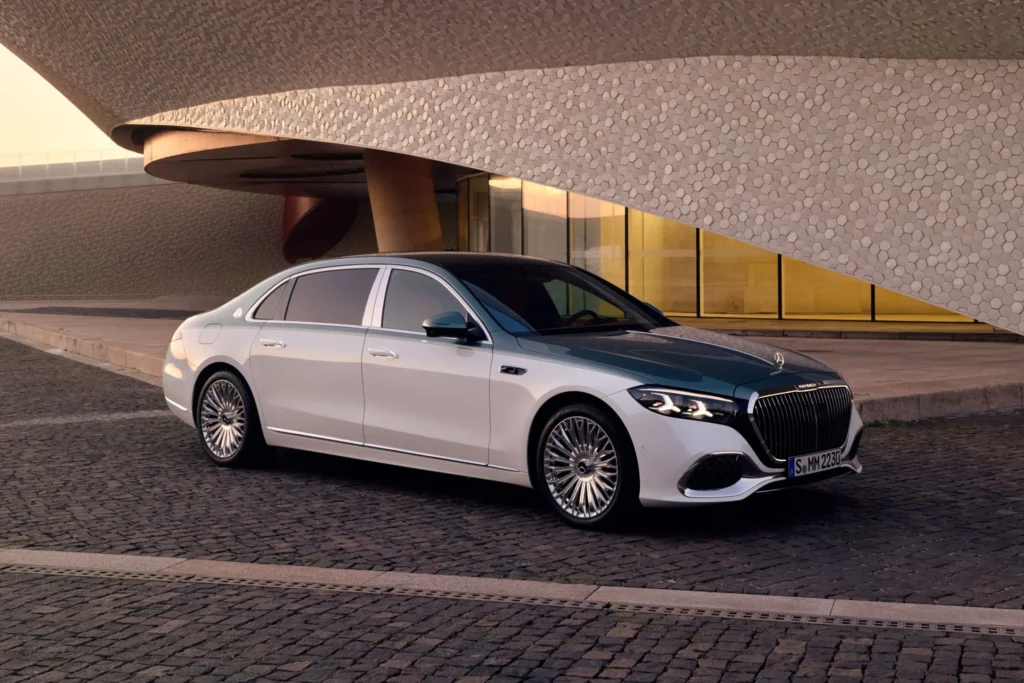
The facelift isn’t limited to what’s under the bonnet. Mercedes-Maybach has adopted the broader visual changes introduced with the updated Mercedes-Benz S-Class, while keeping its own distinctive details. The grille is now roughly 20 per cent larger, making an already imposing front end even more prominent. Buyers can specify illuminated elements too, including the grille surround, Maybach lettering and the Mercedes-Benz three-pointed-star bonnet emblem.
The headlights got one of the bigger technical upgrades. The revised units use micro-LED technology, with Mercedes-Benz claiming a 40 per cent larger illumination field and high-beam reach up to 600 metres. The lighting signature also incorporates star-shaped elements, tying it to the brand’s latest design language. At the rear, the lighting graphics have been redesigned, and revised bumpers add a small amount to overall length. The updated Maybach now measures 5484mm nose to tail, slightly longer than its predecessor. It hardly needed more road presence, but the new dimensions and styling keep the Maybach visually distinct from an ordinary S-Class.
Luxury Remains the Main Event
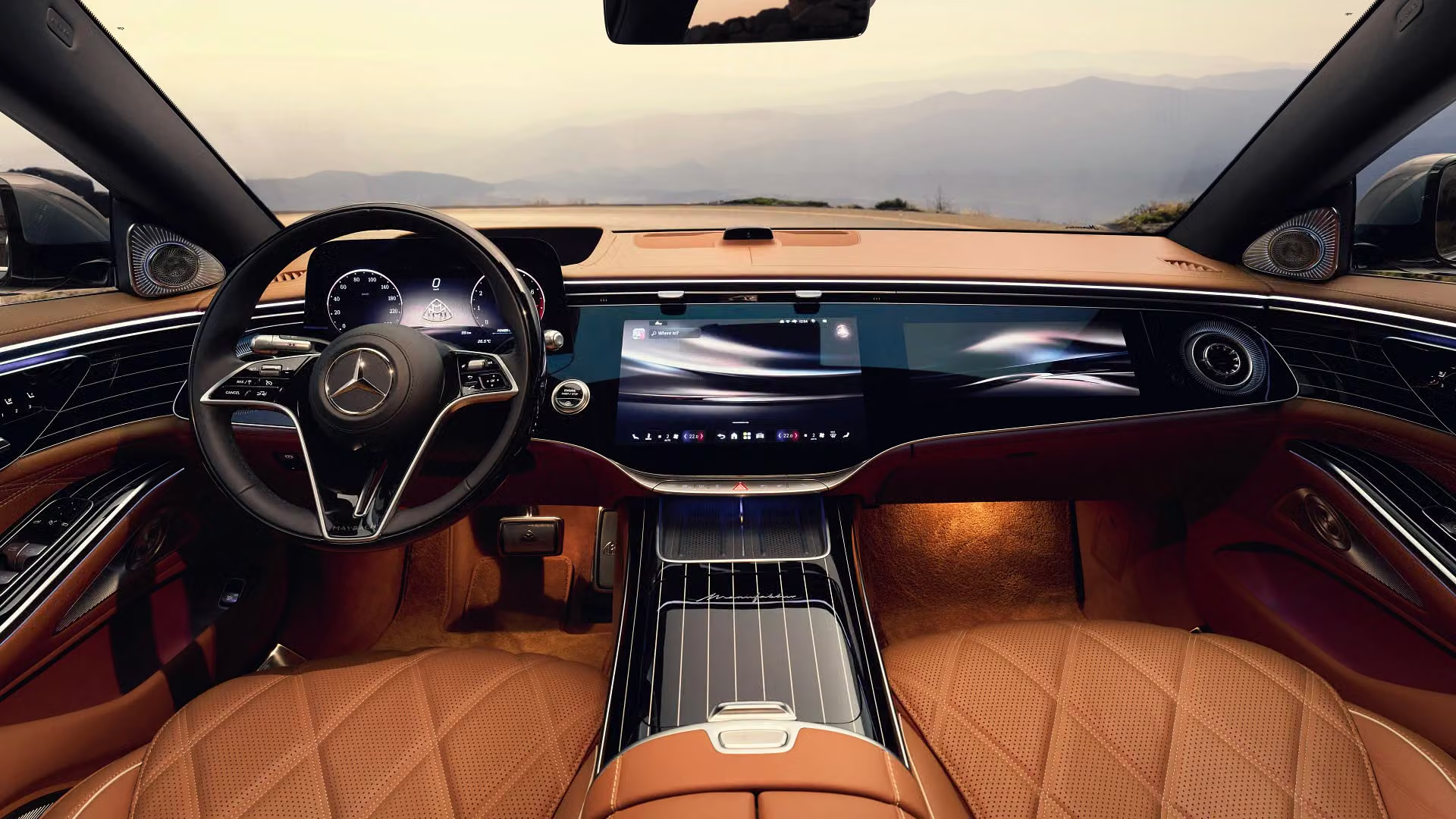
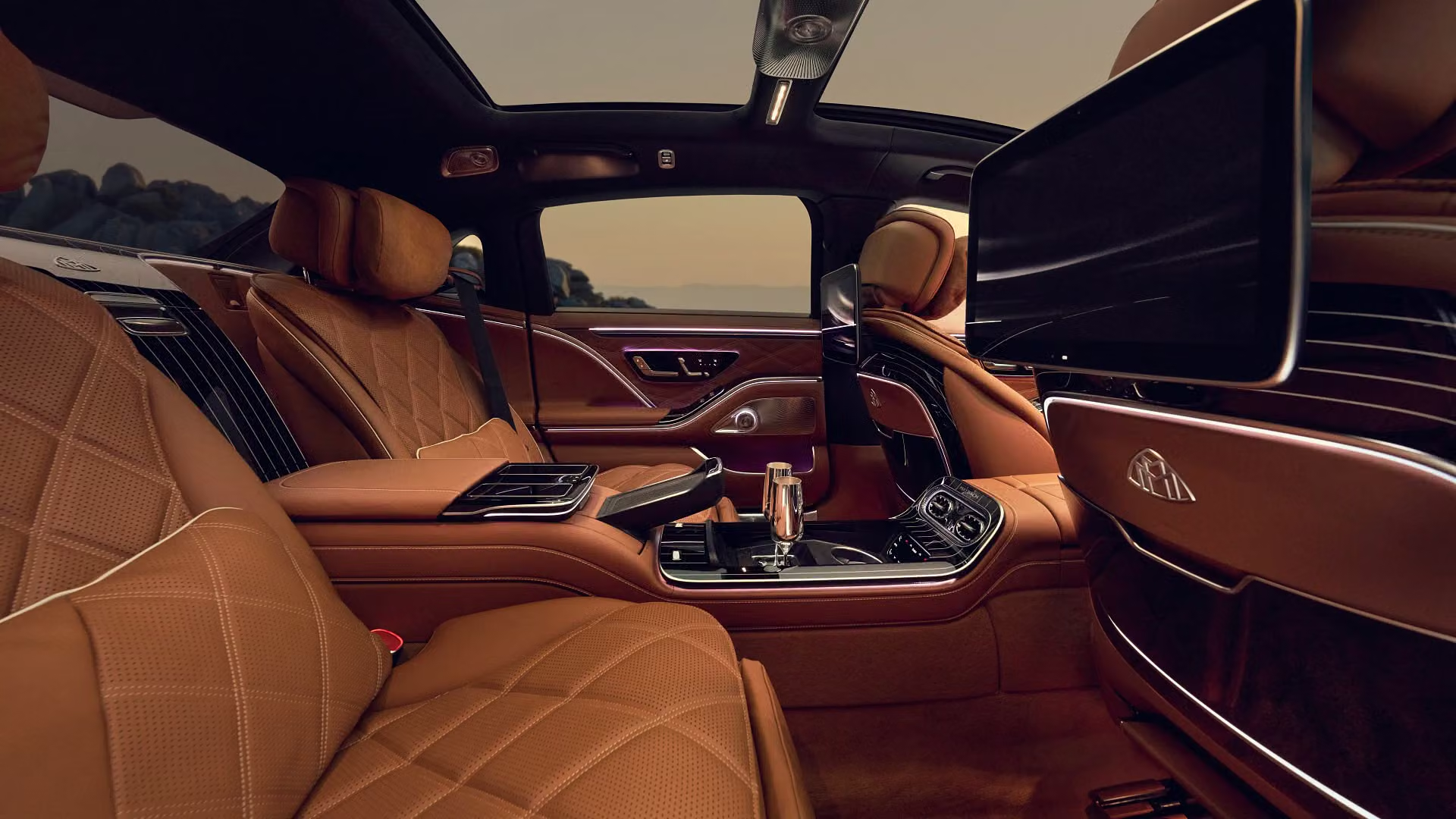
Despite all the talk about engines and technology, the real reason to buy a Maybach is still the cabin. The S-Class has always been Mercedes-Benz’s showcase for comfort technology, and the Maybach pushes that considerably further.
Rear-seat passengers are the priority. The long-wheelbase architecture creates a spacious rear compartment, and Maybach-specific seating, materials and entertainment technology turn the back of the car into something close to a private lounge. The facelift adds updated rear entertainment controls, including individually configurable remotes for the screens mounted behind the front seats.
The broader S-Class update also brings improvements to the digital architecture and driver-assistance tech, with Mercedes-Benz introducing a new generation of computing hardware and its latest MBOS software. For the Maybach buyer, though, technology matters most when it stays out of the way. A luxury limousine shouldn’t require its occupants to understand its electronics. Everything’s meant to work quietly in the background, creating a quieter, smoother, more personalised environment, which matters a lot here since Maybach customers may spend as much time being driven as they do driving.
Chassis Technology for a Very Large Sedan
The Maybach S-Class is enormous, but Mercedes-Benz has worked to make its size feel less intimidating from behind the wheel. Air suspension is standard, isolating the cabin from road imperfections while keeping the composure expected of a flagship sedan. Rear-wheel steering is standard too, with the rear wheels turning up to 4.5 degrees. That’s particularly useful in cities, where cutting the effective turning circle of a car measuring nearly 5.5 metres makes manoeuvring considerably easier, while also adding stability at higher speeds. That dual role sums up the engineering philosophy behind the Maybach. The technology isn’t there to make the car faster. It’s there to make an exceptionally large vehicle feel manageable and refined, which matters more here than chasing lap times.
The S580 Changes the Buying Decision
The new Australian pricing creates a genuinely interesting choice. At $517,900 before on-road costs, the S580 is hardly an entry-level car, but within the world of Maybach, it’s a meaningful cut in the price of admission.
The S680’s new $582,428 starting price is $5,828 higher than before, according to Mercedes-Benz Australia’s pricing reported by CarExpert, leaving a gap of more than $64,000 between the two models. For a buyer in this segment, that’s enough to influence specification choices, money that could go toward bespoke paint, interior finishes, additional equipment or other personalisation instead.
More importantly, the S580 removes the need to choose the V12 just to get the Maybach experience, which could broaden the model’s customer base. Some buyers may have always wanted a Maybach but saw the S680’s price and V12 as more than they needed. The S580 gives them an alternative that still delivers enormous performance and the full suite of Maybach luxury features.
A Different Kind of Competition
The S-Class Maybach sits in an unusual spot in the luxury-car market. It’s more exclusive and expensive than a conventional Mercedes-Benz S-Class, while sitting in the same broad territory as the Bentley Flying Spur and Rolls-Royce Ghost. Mercedes-Maybach’s approach is somewhat different, though. Rather than focusing purely on traditional coachbuilt luxury, it combines old-world extravagance with the technology and manufacturing scale of a modern German luxury maker. That’s especially clear in the new S580: the V8, the mild-hybrid system, the advanced lighting, the digital architecture and the sophisticated chassis systems are all products of modern engineering, while the Maybach badge, the rear-seat focus and the extravagant presentation stay rooted in a much older idea of luxury. The result tries to bridge both worlds.
Why the V8 Matters Now
Maybe the most interesting thing about the 2027 Maybach S-Class is that the new V8 isn’t just an engine built to hit a lower price point. Mercedes-Benz attempts to extend the life of a powertrain configuration many expected to become increasingly rare.
The company is developing electrified vehicles at the same time it’s refining combustion engines to meet future emissions standards, and the S580 sits right at that intersection: 395kW of V8 performance, 750Nm of torque, mild-hybrid assistance. The S680 continues to preserve the theatre and exclusivity of a twelve-cylinder engine.
That gives the Maybach range a clear hierarchy. The S580 is the modernist choice. The S680 is the traditionalist’s ultimate statement. Both arrive in a market where buyers at this level increasingly have electric alternatives in front of them, yet there’s still a real appetite for the character of a large petrol engine.
The Maybach Formula Evolves
The facelifted 2027 Mercedes-Maybach S-Class is more significant than its cosmetic changes suggest. It’s a refinement of the Maybach concept, not a reinvention. The new S580 gives Australian buyers a lower-priced route into the range without giving up much performance. The S680 holds its position as the V12 flagship. The exterior gets more distinctive, the lighting technology advances, and the cabin gains another layer of digital sophistication.
The underlying philosophy hasn’t changed, though. This is still a car built around the idea that luxury should be effortless. Its enormous dimensions hide behind rear-wheel steering. Its V8 gets electrical assistance rather than being abandoned. Its advanced technology aims to reduce effort rather than demand attention. And the rear cabin remains the centre of the experience.
Written By: Leah Kim
Published On: 28th August 2026