
For more than two decades, one of Piet Mondrian’s most important abstract paintings has been largely absent from public view. This autumn, it returns to the spotlight and could become one of the most significant Mondrian sales of the decade.
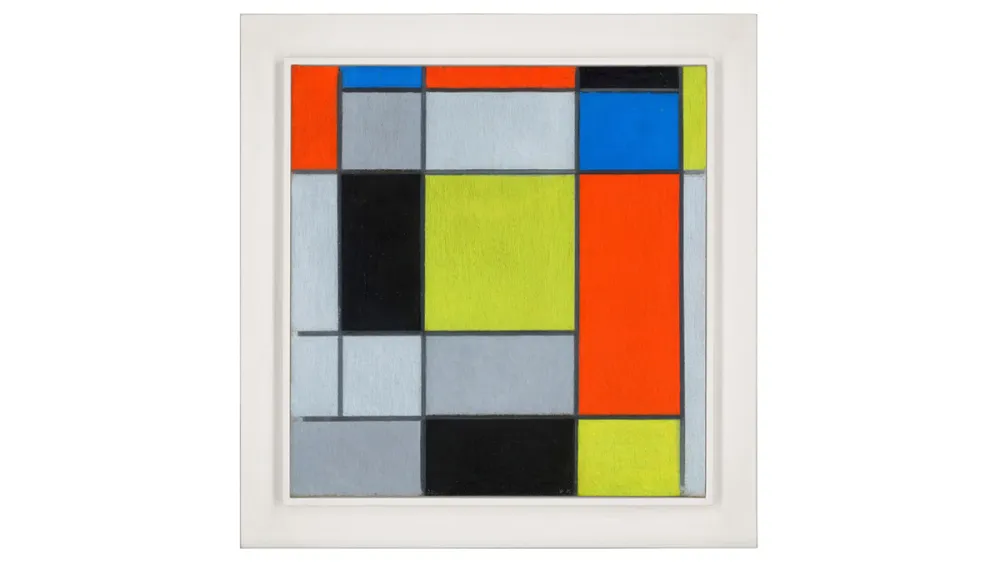
Composition III, painted in 1920, goes to Christie’s London during Frieze Week carrying an estimate of £20 million to £30 million. It’s being offered at auction for the first time in its history, a combination of rarity, provenance and historical importance that makes it an unusually compelling proposition for the art market.
Christie’s calls it one of the most important and rarest Mondrian paintings to reach the market, noting it was one of only eight paintings Mondrian completed in 1920, five of which are now held by major museums. The painting sells on 14 October 2026 as part of Christie’s 20th/21st Century: London Evening Sale, placing it at the centre of one of Europe’s most closely watched weeks for modern and contemporary art. Its significance goes well past the potential price, though.
A Painting From a Defining Moment
To understand the attention around Composition III, it helps to look at where Mondrian was in 1920. The Dutch artist had spent years moving away from conventional representation. His earlier work drew heavily on landscapes, trees and architecture, but his approach was getting steadily more abstract, and by the early 1920s he was pursuing a radically simplified visual language built around horizontal and vertical lines, geometric planes and primary colours.
This was the period when the principles behind his mature Neo-Plastic style were taking shape. Rather than reproducing the visible world, Mondrian wanted painting to work through an autonomous set of relationships, line against line, colour against non-colour, proportion against proportion. A tree could be reduced to its structural essence. A landscape could disappear altogether. What remained was an ordered system expressing balance without relying on recognisable imagery.
Composition III belongs directly to that breakthrough. Christie’s identifies it as a defining example of the moment Mondrian’s abstract language fully crystallised, not just an early example of a famous style, but a document of that style actually being invented.
The Power of Reduction
At first glance, Mondrian’s mature paintings can look deceptively simple: straight lines, rectangles, white space, blocks of colour. That simplicity is the product of an extraordinarily controlled process. Mondrian cared about equilibrium. The position of a line, the proportion of a coloured area, the relationship between empty and occupied space, all of it could radically shift the visual tension of a composition. Nothing was meant to feel accidental.
That’s part of what makes work from this period so hard to replace. Mondrian’s grid has become one of the most recognisable motifs in twentieth-century art, turning up endlessly in fashion, architecture, advertising and graphic design. But a genuine painting from the moment that language was being established is a different thing entirely. Composition III isn’t just an example of a familiar aesthetic. It’s part of the history that made the aesthetic possible.
Why 1920 Matters
1920 holds a special place in Mondrian’s career. By this point, he’d spent years working through increasingly abstract variations, shaped by Cubism and his own philosophical ideas about art, and he’d become deeply involved with De Stijl, the Dutch artistic and design group associated with figures including Theo van Doesburg.
His ideas were becoming more systematic. He believed painting could reach a universal form of expression through the careful organisation of fundamental visual elements, a philosophy that went well past the traditional idea of depicting a subject. For Mondrian, abstraction wasn’t just about making an image less recognisable. It was an attempt to construct a new visual reality, and that ambition is essential to understanding why Composition III commands this much attention today. It belongs to the moment Mondrian’s ideas moved from experimentation toward a mature artistic system.
One of Only Eight
Rarity is another major factor here. According to Christie’s, Mondrian completed only eight paintings in 1920, five of which now sit in internationally renowned museum collections, leaving very few opportunities for private collectors to acquire a work of comparable importance from this specific year.
The art market throws around words like “rare” and “important” a lot, but rarity can mean several different things: few examples exist, most are held institutionally, the artist produced relatively few works, or a particular period rarely comes up for sale. Composition III checks several of those boxes at once. It comes from a pivotal year, belongs to an exceptionally small group, and has spent much of its recent history away from the public auction market, the kind of scarcity that can drive intense competition among collectors.
A Long Absence From the Market
The painting’s return matters partly because it hasn’t been regularly circulating through the auction system. Recent reports say it’s been out of public view for roughly 25 years. Major works that appear at auction repeatedly become familiar to the market. Collectors know their previous prices, their auction history, sometimes even the circumstances around earlier sales. A painting appearing publicly for the first time is a different proposition entirely: no previous auction price attached, no established hammer-price trajectory. Buyers have to assess it mainly through artistic importance, provenance, condition, rarity and their own desire to own it. That uncertainty can be powerful. The market is essentially being asked to set a new benchmark for the painting.
The Provenance Behind the Canvas
The painting also carries a distinguished ownership history. Among its previous custodians were American architect and collector Armand P. Bartos and his wife, Celeste, placing the work within a broader history of twentieth-century cultural patronage. Provenance matters enormously at this level of the market. For an artwork valued in the tens of millions, buyers aren’t simply purchasing an image on canvas. They’re acquiring an object with a historical record, and a strong chain of ownership adds confidence about authenticity, context and significance. In this case, the history confirms Composition III has been treated as an important modernist object long before this auction appearance.
A Global Tour Before London
Before the painting reaches the auction room, Christie’s is giving potential buyers around the world a chance to see it. The work travels to Zurich, Paris, New York and Hong Kong before returning to London for its auction preview, going on public view in London from 8 October ahead of the 14 October sale. At this price level, an auction is no longer a purely local event. The likely audience spans the major collecting centres of Europe, North America and Asia, and the touring programme lets Christie’s build interest before bidding starts. For a painting that’s spent years away from public view, the tour also serves another purpose: it reintroduces the work to the international art world, effectively relaunching it.
Why London Matters
The choice of London is strategic too. The sale happens during Frieze Week, when collectors, galleries, museums, advisers and dealers from around the world converge on the British capital, creating an unusually dense ecosystem of art-market activity. A major Mondrian appearing during that window has real potential to become one of the defining works of the week.
Christie’s has positioned the painting as the most important Mondrian to come to auction in Europe since 2009, a meaningful comparison. That year, Christie’s sold several important Mondrian works from the celebrated Yves Saint Laurent and Pierre Bergé collection, including Composition avec bleu, rouge, jaune et noir from 1922, which made €21.5 million and set a world auction record for the artist at the time. That sale showed the extraordinary appetite for exceptional Mondrians. Seventeen years later, Composition III arrives in a very different market.
A Market Benchmark in the Making
The £20 million to £30 million estimate is ambitious, but the painting’s importance backs it up. If it reaches the top of that range, it becomes one of the most valuable Mondrian paintings ever sold at auction. The comparison with the artist’s existing auction record is worth noting. Christie’s set Mondrian’s current benchmark in 2015, when another Composition No. III, from 1929, sold for approximately US$50.6 million. That the record-setting work comes from a later period highlights how broad Mondrian’s market actually is. Collectors aren’t interested in just one narrow phase. They want significant examples across his evolving visual language, but Composition III could still draw particular attention because of its date. The early 1920s mark the point when Mondrian was moving decisively toward the geometric vocabulary that would make him one of the defining figures of modern abstraction.
The Difference Between Famous and Important
Mondrian presents an interesting challenge for the art market because his imagery is so widely known. A painting can be instantly recognisable without necessarily being historically significant. The most valuable Mondrians aren’t valuable simply because they contain red, yellow, blue, black and white. Their importance comes from where they sit within the artist’s development.
That distinction matters especially with Composition III. Christie’s is presenting it as evidence of a major transformation in twentieth-century art rather than a decorative example of Mondrian’s signature style, so its value ties to art history as much as aesthetics. The canvas represents a moment when painting was being stripped to its fundamental components and rebuilt around abstraction, a transformation that would go on to influence generations of artists, designers and architects.
Why Collectors May Be Watching Closely
For a private collector, buying Composition III offers something increasingly hard to find: a museum-calibre work with no previous auction history. There are relatively few chances to buy something that combines canonical status with genuine market freshness.
The buyer is also acquiring a work with a broad cultural footprint. Mondrian’s influence reaches past painting into graphic design, fashion, architecture and popular culture, helping establish the idea that simple geometric structures could form a complete artistic language. Owning a major work from that formative period carries significance beyond the individual canvas. It’s a piece of the development of modern visual culture.
The Bigger Question: What Is a Mondrian Worth Today?
The auction will ultimately test more than one painting. It’ll test the current market’s appetite for twentieth-century modernism at the highest level. Contemporary art has dominated headlines for years, but major modernist works keep attracting collectors because their historical importance is already established, and Mondrian sits in an especially strong position within that market: his best works are instantly recognisable, institutionally important and genuinely scarce. Those qualities are hard to manufacture, and as the market gets more selective, that combination could become even more valuable. Collectors increasingly want works likely to hold cultural significance across generations rather than just fashionable names, and Composition III fits that description well.
More Than a $40 Million Painting
It’s tempting to focus on the potential price. A £30 million estimate is headline material, especially for a painting that’s never appeared at auction before. But the number doesn’t explain why the work matters. Its real significance lies in its timing, its rarity, and its role in Mondrian’s shift from representational painter to one of abstraction’s defining pioneers.
Written By: Leah Kim
Published On: 28th August 2026