
In the rarefied world of collector automobiles, provenance can elevate machinery into mythology. Few cars embody this transformation as completely as the BMW M1 presented to Niki Lauda after his triumph in the 1979 Procar Series. More than a supercar, it is a tangible reward from an era when Formula 1’s brightest stars raced door-to-door in identical machines. Now, this singular artifact of motorsport history is poised to pass from legend to lucky custodian.
When Formula 1 Needed a New Stage
The late 1970s were a moment of both ambition and frustration for BMW Motorsport. The company had conceived the M1 as a homologation special, intended to dominate international GT racing. Delays, shifting regulations, and an unexpectedly complex production process conspired to leave BMW with a sensational mid engine supercar, and nowhere to race it.
Rather than retreat, BMW improvised with audacity. The solution was the Procar Series, a one make championship staged alongside European Formula 1 Grands Prix in 1979. Its premise was deliciously simple: place the world’s best drivers in identical BMW M1 race cars and let talent, not technology, decide the outcome. On Saturday afternoons, before the F1 cars even fired up, fans were treated to battles between reigning champions, rising stars, and seasoned privateers. It was motorsport distilled to its essence, and the grid read like a roll call of greatness.
A Gladiatorial Lineup
The Procar paddock featured names that defined an era: Emerson Fittipaldi, James Hunt, Gilles Villeneuve, Nelson Piquet, Alan Jones, Jacques Laffite, Carlos Reutemann, and Clay Regazzoni among them. Each race paired Formula 1 aces against accomplished privateers, all driving machines prepared to the same specification. There were no excuses, only skill, nerve, and racecraft.
Amid this extraordinary field, Niki Lauda emerged as the benchmark. Known for his analytical precision and relentless consistency, Lauda mastered the Procar format with surgical efficiency. Victories at Monaco, Silverstone, and Hockenheim, complemented by a strong finish at Monza, delivered him the championship. BMW’s reward was fitting: a road going BMW M1, presented not merely as a car, but as a symbol of dominance over one of the most competitive grids ever assembled outside Formula 1 itself.
The M1: BMW’s First Supercar
To understand the weight of that prize, one must understand the M1 itself. This was BMW’s first car to wear the now iconic M badge, and it arrived with the confidence of a brand stepping into uncharted territory. The M1 was also BMW’s first mid engine production car, a bold departure from its sporting sedans and coupes.
Under its sharply tailored bodywork lay a 3.5 liter inline six engine, mounted just behind the cockpit. Producing 266 horsepower in road trim, it was paired with a five speed ZF manual transmission and capable of speeds that placed it squarely among Europe’s elite exotics. The engine’s character was unmistakably BMW: smooth, mechanically honest, and eager to rev.
Visually, the M1 was no less distinctive. Designed by Giorgetto Giugiaro, its wedge shaped silhouette balanced aggression with restraint, less flamboyant than Italian contemporaries, yet undeniably exotic. It was a supercar filtered through German discipline.
A Personal Touch from Motorsport Royalty
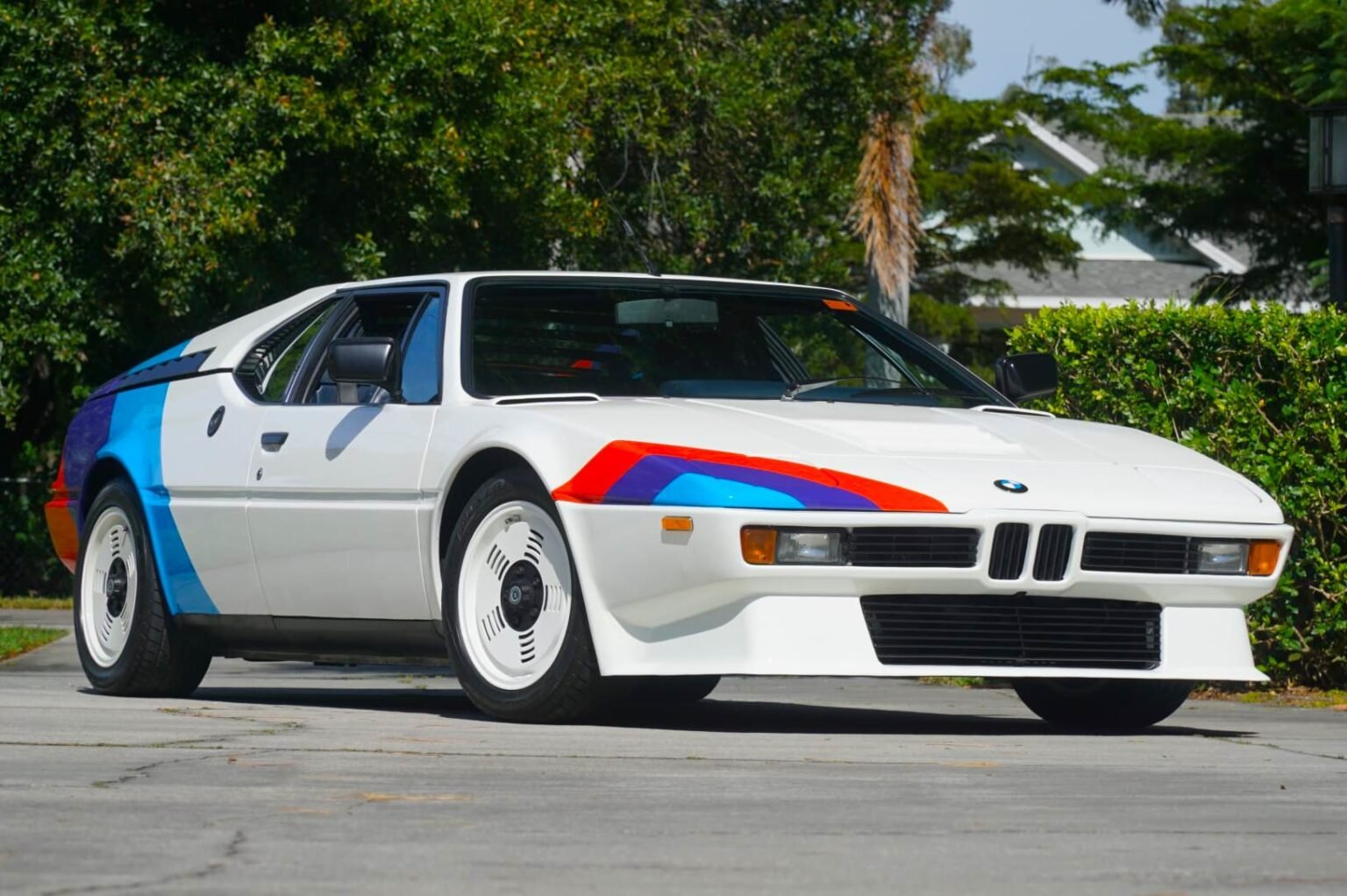
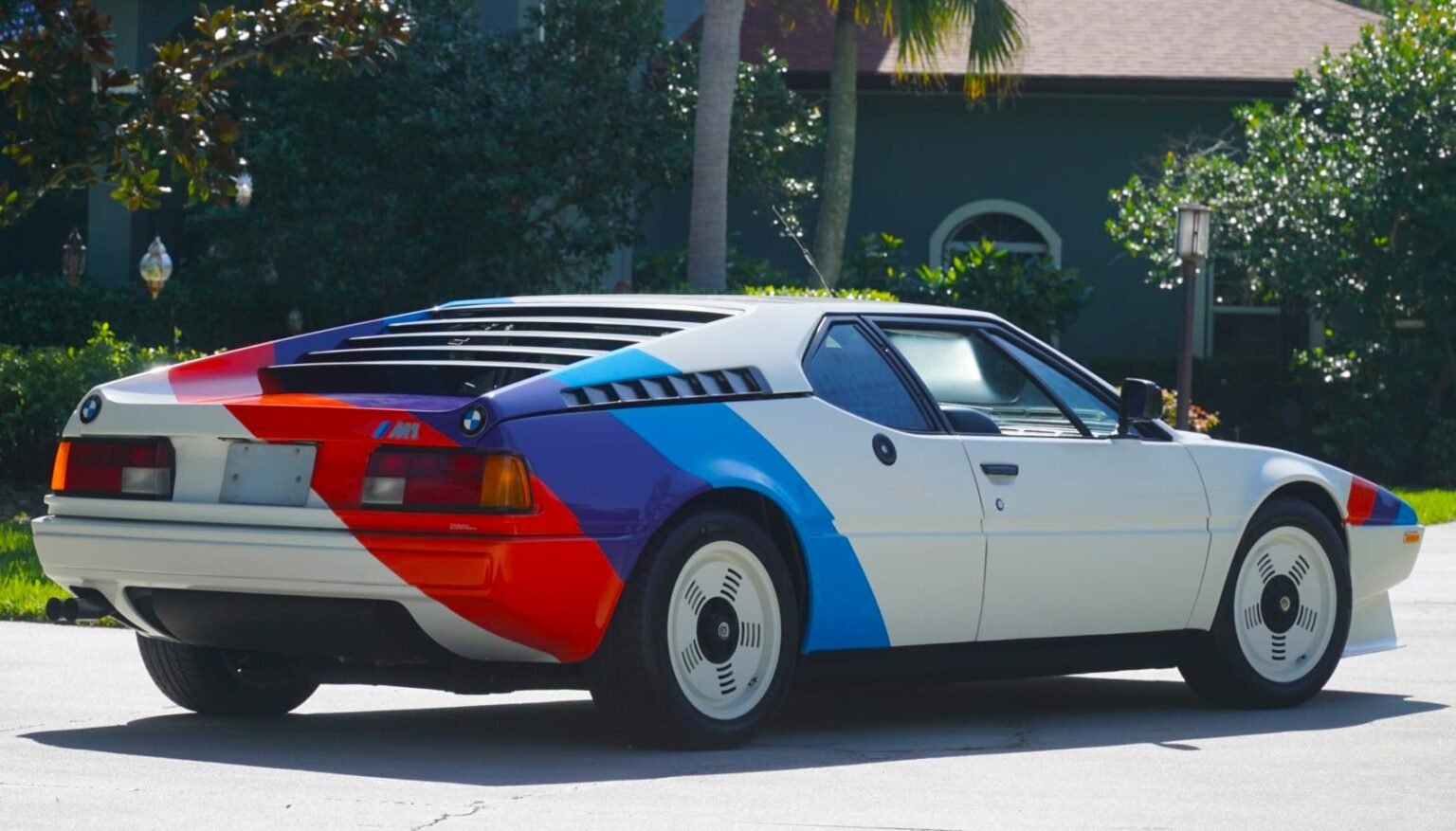
Lauda’s M1 is not simply one of the 399 road cars produced; it carries details that elevate it beyond rarity into narrative. The exterior wears BMW Motorsport tri color striping, hand applied by celebrated artist Walter Maurer, whose association with BMW’s Art Car program lends the finish cultural as well as automotive significance.
The car also features a Procar style front air dam, visually linking it to the fire breathing racers Lauda drove to victory. Inside, a blue leather cabin offers an unexpected softness, a reminder that this was a road car meant to be driven, not entombed.
Despite its importance, the M1 has lived a life rather than languished in storage. With modest mileage accumulated over decades, it presents today in remarkably preserved condition, patinated just enough to feel authentic, yet carefully maintained to honor its stature.
Lauda Beyond the Numbers
Niki Lauda’s legacy cannot be reduced to championships alone, though three world titles would suffice for immortality. His influence extended beyond raw speed to the very philosophy of racing professionalism. Lauda approached competition as both a driver and an engineer, famously demanding clarity, preparation, and accountability from teams that had grown accustomed to chaos.
The Procar Series suited him perfectly. In identical machinery, Lauda’s calm intelligence consistently outmatched more flamboyant rivals. His success was not about spectacle, but inevitability, a quality that defined his greatest seasons in Formula 1 as well. Owning Lauda’s M1 is therefore not just about acquiring a rare BMW. It is about holding a physical expression of Lauda’s mindset: disciplined, purposeful, and ruthlessly effective.
Collectibility in a Different Key
In today’s collector market, supercars are plentiful and provenance is king. A low mileage BMW M1 alone commands respect, but one gifted to a driver of Lauda’s stature occupies a different category entirely. It bridges multiple worlds: Formula 1 history, BMW Motorsport heritage, and the golden age of analog supercars.
Unlike many celebrity owned vehicles, this M1’s significance is not incidental. It was earned in competition, awarded in recognition of excellence, and personalized through factory and artistic collaboration. Such layered authenticity is increasingly rare, particularly as motorsport becomes more corporate and less intimate. For collectors, this is not merely an acquisition. It is stewardship.
A Moment Before It Moves On
As this BMW M1 heads to auction, it represents a fleeting opportunity. Cars like this do not circulate often, and when they do, they redefine expectations. Whether displayed under museum lights or exercised on open roads, its value lies not only in numbers, but in memory.
This M1 tells a story of a brief, brilliant chapter when Formula 1 champions raced identical cars for pride, when manufacturers rewarded victory with something tangible, and when driving excellence translated directly into ownership of greatness. To claim it is to claim a fragment of racing’s most romantic era, one shaped by talent, courage, and a man named Niki Lauda.
Written By: Lydia Kelly
Published: 16th December 2025