
For fifty years, BMW has been asking what happens when a racing car becomes a canvas. Since 1975, the company has commissioned 20 internationally known artists to reinterpret its cars, turning race machines, road cars and prototypes into what BMW calls “rolling sculptures.”
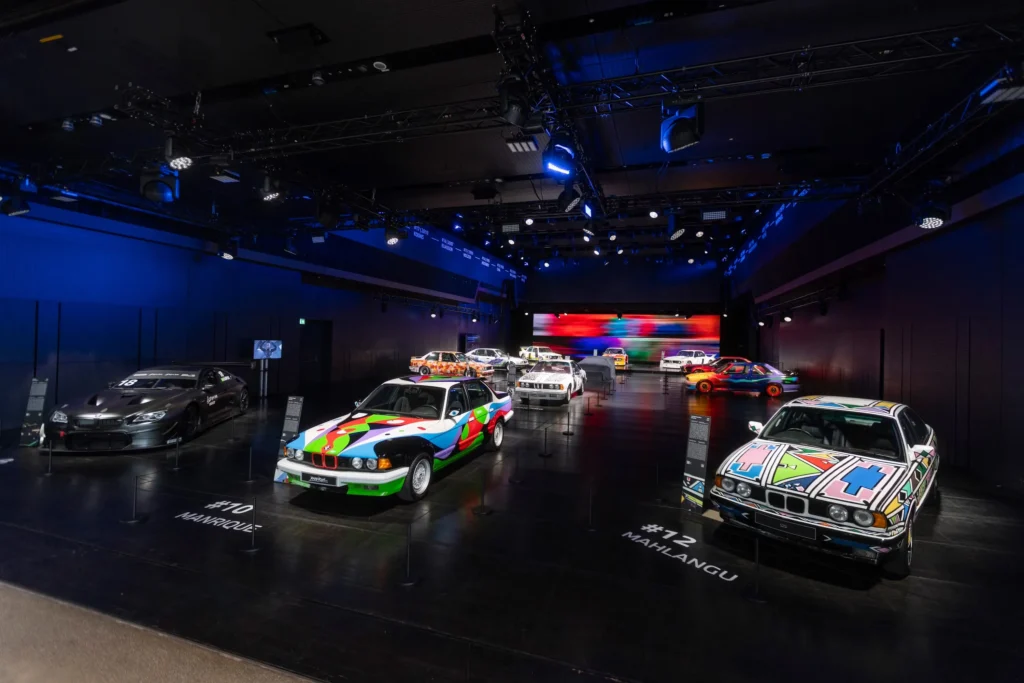
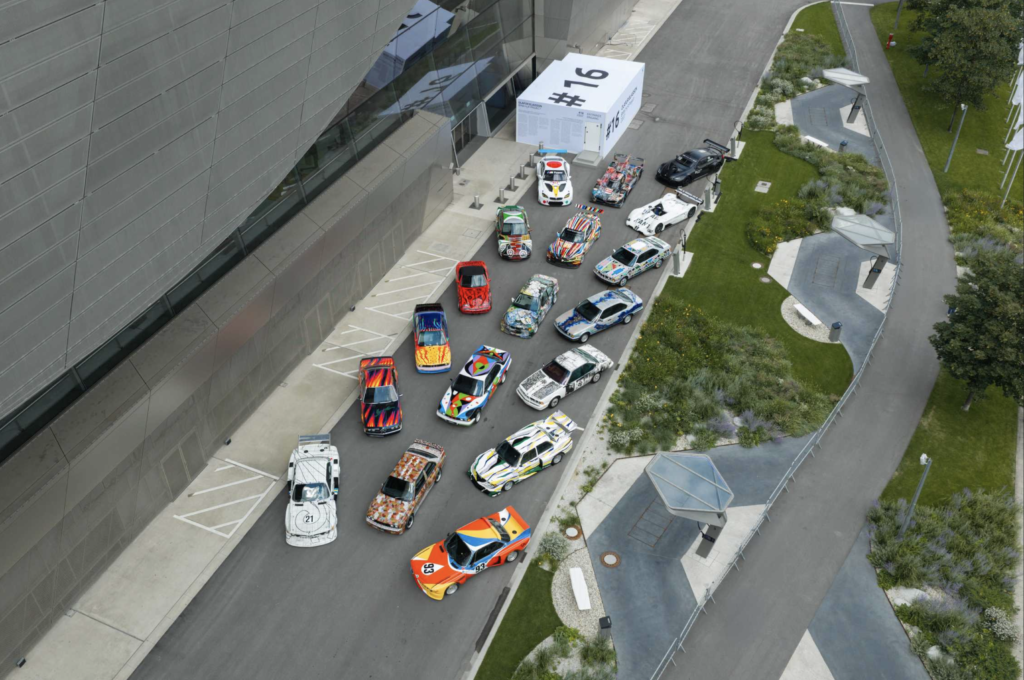
Now the whole collection is together for the first time. At BMW Welt in Munich, all 20 BMW Art Cars are reunited for BMW Art Cars – 20 Artists, 50 Years of Innovation, running July 29 to August 31, 2026. It marks the programme’s 50th anniversary and the end of its World Tour, which has already visited more than 30 countries. Admission is free.
This isn’t just a display of expensive, historically significant cars. Seen together, the 20 cars tell a broader story about design, technology, popular culture and how the car itself has been understood over five decades. Few collections make that shift so visible.
It started with a race car
The project’s origin is fairly casual. In 1975, French racing driver and art auctioneer Hervé Poulain approached Jochen Neerpasch, then head of BMW Motorsport, with an idea: get a major artist to transform a BMW racing car, then run it at Le Mans. The artist was Alexander Calder, the American sculptor known for kinetic work and bold colour.
The canvas was a BMW 3.0 CSL. Calder worked with the car’s shape rather than against it, running blocks of colour across the bodywork so the effect changed with speed and angle.
Poulain raced it at Le Mans with Sam Posey and Jean Guichet. It worked as more than a publicity stunt. It set up a new relationship between motorsport and contemporary art. Nobody involved could have known it would become a 20-car collection spanning fifty years. It was meant to be a one-off. It became an institution.
From Calder to the world
The second Art Car came a year later, when Frank Stella applied his visual language to another 3.0 CSL. Then Roy Lichtenstein. Then Andy Warhol.
The project started pulling in artists whose names were already tied to major movements in modern art. Their approaches varied a lot, but the challenge stayed the same: transform a working car without erasing what it actually is underneath.
An Art Car still has to deal with aerodynamics, doors, wheels, glass, reflection, and motion. That’s why the cars sit somewhere between commissioned art, industrial design and motorsport engineering, and that hybrid identity has stuck with the programme the whole way through.
The collection becomes a time capsule
The 20 cars in Munich span a wide stretch of BMW’s history. It starts with Calder’s 1975 3.0 CSL and runs through the BMW 320i Turbo, M1, 635 CSi, M3 Group A, 535i, Z1, 850 CSi and V12 LMR. The more recent entries move into a different era, with the M6 GT3, M6 GTLM, and most recently the M Hybrid V8.
That progression gives the exhibition a second story beyond the art. The cars track BMW’s own evolution. The early Art Cars belong to the analogue era of racing and design. The later ones belong to a digital, electrified world. The programme ends up working as a kind of parallel history of the company.
As the cars changed, the artists’ responses changed with them. As technology changed, so did what the project actually meant.
Andy Warhol’s M1 and the arrival of pop culture
Few Art Cars are as instantly recognizable as Warhol’s BMW M1. Made in 1979, it became a vivid statement of movement and colour, and it helped cement one of the project’s core ideas: a car didn’t need distance from popular culture to count as art.
The M1 was already an icon on its own. Warhol folded its speed and physical presence into the artwork itself, and it showed how naturally cars fit into the language of Pop Art. It also showed why using famous artists mattered in the first place. These weren’t anonymous decorative jobs. Each artist brought their own visual language and their own place in the cultural conversation.
Art that crossed continents
As the collection grew, it got more international. The 1980s and ’90s brought in Ernst Fuchs, Robert Rauschenberg, Michael Nelson Jagamara, Ken Done, Matazo Kayama, César Manrique, A.R. Penck and Esther Mahlangu.
That range matters. Mahlangu’s 1991 BMW 525i brought Ndebele visual traditions into the project. David Hockney’s 1995 850 CSi went a different way, using the car to explore perception and representation.
Jenny Holzer’s 1999 V12 LMR brought text into the mix, and later projects leaned into technology, virtuality and globalisation. There’s no single BMW aesthetic here. There are 20 different takes on what a car can represent.
When the car stops being a canvas
At some point, artists stopped just decorating the exterior. Olafur Eliasson’s BMW H2R Project is the clearest example. Made in 2007 as Art Car number 16, it’s built on BMW’s hydrogen-powered H2R prototype. Eliasson stripped off the standard bodywork and replaced it with a sculptural mesh structure covered in layers of frozen water.
It reads less like a painted car and more like an installation built around a vehicle. The frozen structure weighs about two tonnes and is lit from within. Instead of celebrating the machine, Eliasson’s piece asks questions about energy, sustainability, nature and technology.
Its presence in Munich matters. The H2R Project has only been shown publicly as a complete frozen installation a handful of times since 2007. BMW Welt is only the fourth venue to show it that way, which makes it one of the stranger, more conceptually loaded objects in the whole exhibition.
Julie Mehretu brings the story into the present
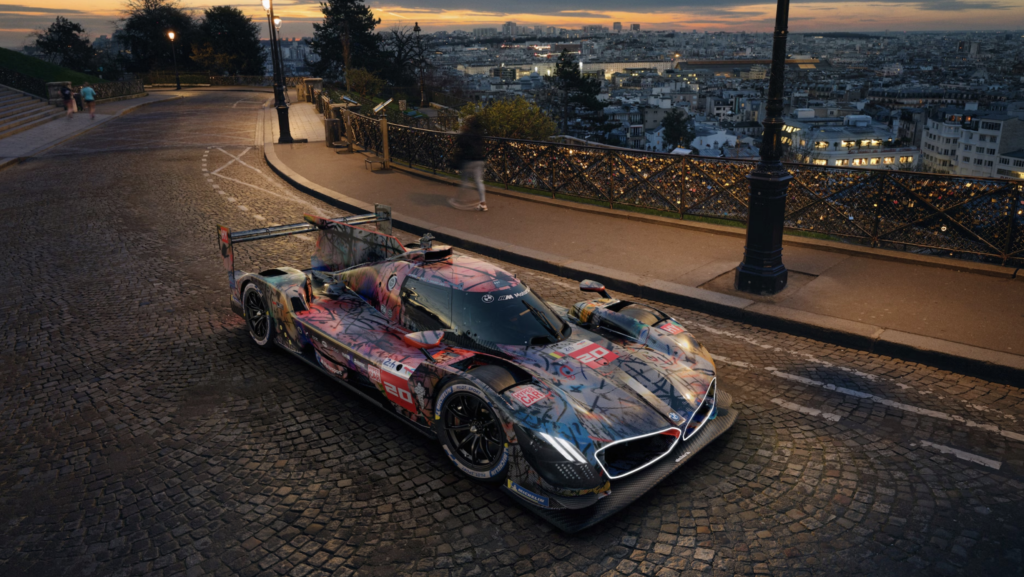
If Calder marks the start, Julie Mehretu marks where the project stands now. Her BMW M Hybrid V8 is the 20th and newest Art Car, made in 2024. The car itself matters here: the M Hybrid V8 is a current endurance racer, mixing BMW’s modern performance approach with electrified tech. Mehretu pulled elements from her painting Everywhen and translated them onto the car’s three-dimensional form, with grids, marks, colour and layered information that reads as movement even when the car’s standing still.
Her involvement didn’t stop at the car, either. The project also led to the African Film and Media Arts Collective, created with film producer and screenwriter Mehret Mandefro, which BMW says supports artists and filmmakers from Africa and its diaspora. A modern Art Car isn’t only about painting a vehicle anymore. It can be a starting point for something much bigger.
The exhibition itself moves backwards through time
BMW chose an unusual way to lay out the collection. Instead of starting with Calder and moving toward Mehretu, visitors see the newest cars first: Mehretu’s Art Car #20 and John Baldessari’s #19 greet you at the entrance. From there you move backwards through the decades, with a timeline tracking both the art and the technology.
The path ends at the beginning. Calder’s 3.0 CSL sits at the centre of the final room. It’s a smart curatorial choice. Seen in reverse, you notice just how far the idea has travelled. The futuristic M Hybrid V8 at the start feels almost nothing like the 1975 CSL at the end, and yet they’re both part of the exact same experiment.
BMW Welt as the final canvas
The venue matters too. BMW Welt isn’t a conventional museum. It’s a major architectural landmark, visitor centre and public space where BMW’s products, technology and culture already sit side by side. That makes it a natural home for the full collection, rather than pulling the cars out of BMW’s identity and into a neutral gallery.
BMW says the venue draws millions of visitors a year, so the exhibition reaches well beyond typical art crowds or motorsport fans. That’s always been one of the Art Car programme’s real strengths: making contemporary art approachable through something familiar.
You don’t need to know conceptual art history to be drawn to a Warhol-covered M1. You don’t need to be a motorsport historian to like the shape of a 3.0 CSL. You don’t need to unpack all of Mehretu’s visual language to feel the energy in her M Hybrid V8.
A digital layer for a new audience
The Munich show also reflects how museum experiences are changing generally. BMW partnered with the Artlas platform to give visitors digital access to information on all 20 cars. Point a phone at a car, and you get background, curated tours, and audio content, built to work for casual visitors and serious collectors alike.
BMW Welt also built a Treasure Hunt to get people exploring the collection actively. It’s a fitting extension of the whole idea: the project started by putting art onto a moving machine, and now it’s using technology to help people actually understand that art.
Why the Art Cars still matter
It’d be easy to write the BMW Art Cars off as an elaborate form of corporate marketing. Fifty years of history makes that read too simple. The project has lasted because the core idea still holds up. Cars are among the most visible technological objects in modern life. They shape how cities get built, how people move, how industries grow, how people think about freedom and progress. Handing those cars to artists created space to question, celebrate or completely reinterpret all of that.
From Le Mans to a museum
The first Art Car raced at Le Mans. Fifty years later, the whole collection sits in a major cultural exhibition in Munich. That shift says something about how much the car’s cultural status has changed. The first Art Car was still, fundamentally, a racing machine, with the art running alongside its competition purpose. Today’s Art Cars can be race cars, design objects, installations, or the starting point for something much bigger. But the tie to performance hasn’t disappeared. Even Mehretu’s M Hybrid V8 keeps the project’s core DNA intact: a real competition car, reshaped through an artist’s eye.
Written By: Leah Kim
Published On: 10th August 2026