
There are rare cars, and then there are cars whose backstory sounds almost too neatly built to be real. The 1996 McLaren F1 GTR chassis 10R is the second kind. It started as a factory development car, built to the latest spec of one of the defining racing machines of the 1990s, tested at Le Mans, converted for road use by McLaren, and eventually bought by Pink Floyd drummer and serious car collector Nick Mason.
After more than two decades in Mason’s hands, the car is going to RM Sotheby’s Monterey auction on August 15, where it’s valued at over $35 million. Some people watching the market think bidding could go well past that, possibly toward $50 million.
Whatever number ends up on the screen, the car matters for reasons that go past the price. Known as the “Pop Art F1,” chassis 10R is one of the rare McLaren F1 GTRs where racing history, factory provenance, a distinctive look and celebrity ownership all line up in one package.
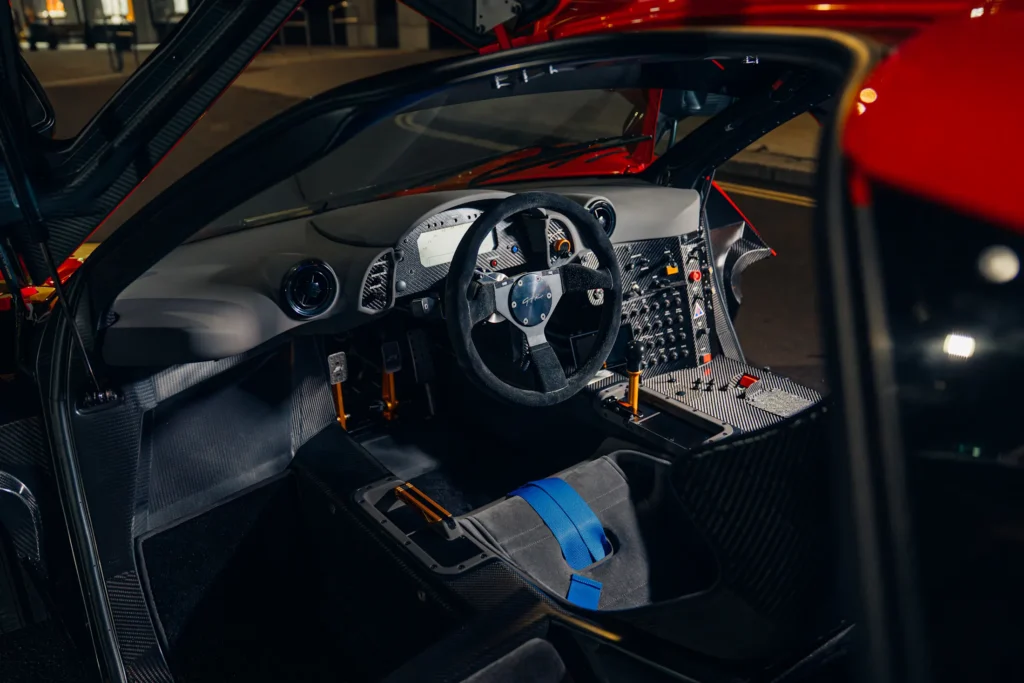
More than a famous owner’s car
A famous owner can add real value to a collectable car, but it rarely creates that value by itself. With 10R, Nick Mason feels almost like one more chapter in a story that was already unusual on its own. McLaren kept the car after building it, and it became the first F1 GTR made to the substantially revised 1996 spec. It’s one of only two short-tail factory “XP” prototypes, the other being chassis 01R, the F1 GTR that won the 1995 24 Hours of Le Mans outright. Only nine GTRs were ever built to that 1996 spec.
Its time at the factory mattered too. The car was developed for McLaren’s next run at Le Mans and went through testing ahead of the 1996 race. At the Circuit de la Sarthe, works driver David Brabham ran it during pre-qualifying. It didn’t actually race, though. Sister chassis 11R took its place on the grid.
That detail matters. Nobody’s selling this as a Le Mans winner that never started the race. Its importance comes from being part of the factory’s development work on the next generation of F1 GTR, built off the back of 01R’s win the year before, work that pushed McLaren’s racing programme meaningfully forward.
The F1 GTR changes the game
The original McLaren F1 was never meant to be a racing car in the conventional sense. Gordon Murray designed the road car as an uncompromising driver’s machine, built around a central driving position, obsessive lightweight engineering, and a naturally aspirated BMW V12. It became one of the defining supercars of its era on those terms alone.
Racing regulations later opened a door for production-based cars to compete, and the F1 was adapted into the F1 GTR. What followed was one of the more unlikely wins in modern endurance racing.
At the 1995 24 Hours of Le Mans, chassis 01R won outright. That result stood out because the F1 GTR wasn’t a purpose-built prototype to begin with. It grew out of a road car, and at Le Mans it beat cars that were built from the ground up for racing. That win changed how people saw the whole F1 lineup.
For 1996, McLaren refined the GTR further, with revised aerodynamics, new bodywork, a more aggressive front splitter, and other changes meant to keep it competitive against rivals that were getting more specialised every year. The 1996 cars also got a lighter magnesium gearbox casing.
Why the paint matters
The mechanical history explains a lot of 10R’s value. Its look explains why people actually remember it. The car wears a bright scarlet-and-yellow design pulled from 1990s pop culture, and it’s not a later owner’s paint job or some aftermarket idea. It’s a factory livery, and according to RM Sotheby’s, the only F1 GTR to wear it.
That’s part of what makes the car so recognisable. Most historically significant racing cars get remembered through their competition livery. Chassis 10R is a bit different, since it became visually distinct without ever actually racing at Le Mans the way 01R did.
The design wasn’t a throwaway choice either. Gordon Murray has said the point was to make something spectators would instantly recognise as different, not just pick a nicer colour off a chart.
The F1 GTR is a genuinely serious piece of racing engineering. 10R still manages to look playful, almost fun, and that graphic treatment gives it a cultural identity that goes past motorsport. That’s really where “Pop Art F1” earns its name, connecting a piece of racing technology to the visual culture of the moment it was built in.

Enter Nick Mason
McLaren sold 10R directly to Nick Mason in 1999. It’s a fitting match. Mason’s known first as Pink Floyd’s drummer and co-founder, but his interest in cars goes back well before his fame as a musician. His collection has included some of the most important road and racing cars of the twentieth century: a Ferrari 250 GTO, a Maserati 250F, a Bugatti Type 35, a Jaguar D-Type, a Porsche 962.
He didn’t just buy 10R to have it sitting somewhere as a trophy.
The car went into an active collection where historically significant machinery actually got driven, maintained and shown. McLaren converted the GTR for road use and registered it in 1999, and specialist firm Lanzante later did further work on it. Lanzante’s involvement adds real motorsport credibility here.
Paul Lanzante had been deeply involved with the F1 GTR programme and led the team behind McLaren’s 1995 Le Mans win. His company later became closely tied to maintaining and converting F1 GTRs for road use generally.
Under Mason, Lanzante kept 10R maintained and carried out significant restoration work twice, once in 2009 and again after an accident at the Goodwood Members’ Meeting in 2017.

Two accidents, and a survival story
The car’s history isn’t spotless. In 2009, a journalist crashed 10R into a wheat field, and Lanzante did a full restoration afterwards. Years later, Mason himself lost control of it at Goodwood in 2017 and put it into a tyre barrier. Lanzante restored it again.
For a normal performance car, two serious accidents might permanently hurt its value. Cars like the F1 GTR don’t really work that way. For collectors, the real question isn’t whether an accident happened. It’s how the repair was done, who did it, and whether the car’s identity and provenance held up afterwards.
In 10R’s case, the work went to a specialist who knew the model inside and out, and the car kept getting serious ongoing maintenance beyond just the accident repairs. RM Sotheby’s calls its condition exceptional as a result. The fact that the car was actually used matters too, for a reason collectors increasingly care about: authenticity.
Mason didn’t spend 25 years keeping 10R under a cover. It showed up at the Goodwood Members’ Meeting, the Goodwood Festival of Speed, and other events. It got driven, maintained, used. That gives it a living history instead of a purely archival one.
Why collectors may pay tens of millions
An estimate over $35 million sounds enormous, but it makes more sense once you break the car’s history into pieces. Start with the McLaren F1 itself. Few modern cars carry that kind of historical weight. Then add the GTR, the version that turned the F1 from an exceptional road car into a genuine motorsport legend.
Then add the 1996 spec, of which only nine were built, with 10R being the first. Then its status as a factory XP prototype and its Le Mans testing history. Then its factory road conversion. Then the unique livery, and 25 years with one of the best-known car collectors in the world. And finally, the ongoing connection to Lanzante, one of the names most tied to the F1 GTR’s whole history.
The end of an era
There’s a bigger reason people care about the F1 GTR beyond any single car’s history. It marks the end of a particular relationship between road cars and race cars, an era when a road-going GT could genuinely be developed into a Le Mans contender and beat purpose-built competition.
The F1 GTR bridged two very different worlds. On one side, a road car built entirely around the driver’s experience. On the other, endurance racing, a brutal test of reliability, aerodynamics, efficiency and raw pace over 24 straight hours. The F1 GTR proved those two things could still meet in the middle.
That’s part of why chassis 10R matters even without a Le Mans win of its own. It’s part of the development line that followed 01R’s 1995 victory, and it helped make the F1 GTR one of the defining racing cars of its time.

Written By: Leah Kim
Published On: 10th Aug 2026