
Few jewellery designs have earned the kind of cultural recognition Bulgari’s Serpenti has. It’s more than a collection of watches and jewels. The serpent has become one of the Roman maison’s defining signatures, a motif that’s survived changing fashions, shifting ideas of femininity, and more than seven decades of design experimentation.
It started in 1948, when Bulgari introduced the first Serpenti bracelet-watch. What began as a clever piece of jewellery and watchmaking eventually grew into necklaces, rings, bracelets, cuffs and elaborate high-jewellery creations, along the way becoming associated with some of the most recognisable women of the twentieth century, most famously Elizabeth Taylor.
What’s remarkable is that Serpenti’s identity has never depended on one fixed design. Like the creature that inspired it, the collection keeps changing shape while keeping its character unmistakable.
The ancient symbolism behind the serpent
Long before Bulgari turned the snake into a luxury object, the creature had already picked up layers of meaning across civilisations. In ancient Egypt, the uraeus, the rearing cobra associated with royalty, represented protection, authority and sovereignty. In the Greek and Roman worlds, snakes were tied to healing, while the ouroboros, a serpent consuming its own tail, became a symbol of eternity and renewal. The snake could stand for danger and protection at once, seduction and wisdom, death and rebirth. That ambiguity would later become central to Serpenti’s appeal.
The serpent also happens to be a natural fit for jewellery. Its elongated body lends itself to the form, and its ability to coil around a wrist, neck or finger lets a designer make a piece that looks almost alive. Bulgari wasn’t the first jewellery house to use the motif. Serpents had shown up in European jewellery for centuries, including the famous ring Prince Albert had made for Queen Victoria in 1839. But Bulgari turned the idea into something distinctly modern, treating the snake not as decoration applied to a jewel, but as the structure of the jewel itself.
The birth of Serpenti in 1948
Bulgari introduced the first Serpenti in 1948 as a bracelet-watch, and the design was genuinely new: it blurred the line between jewellery and timekeeping. Instead of putting a conventional watch on a conventional bracelet, Bulgari disguised the watch inside a serpent-shaped form. Early versions used the Tubogas technique, producing a flexible, coiled gold bracelet that wrapped around the wrist.
Tubogas became one of Serpenti’s most important technical signatures. The construction works by forming metal strips around a temporary core, then removing that core, leaving a flexible, hollow structure that can curve naturally around the wrist without the rigidity of a traditional metal bracelet. It wasn’t just an aesthetic choice. That flexibility let Bulgari build a watch that behaved like jewellery, coiling around the wearer instead of just sitting on the wrist.
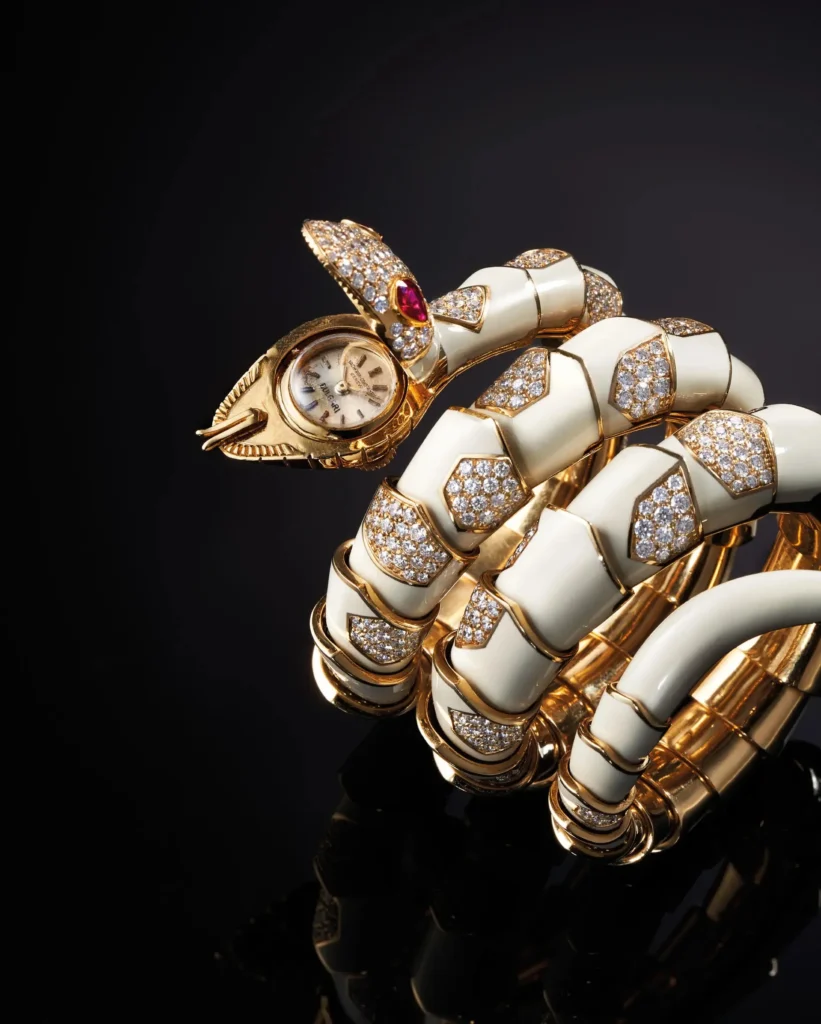
The watch itself started out fairly discreet, but through the 1950s the design got increasingly figurative. Serpenti heads became more recognisably reptilian, with gemstone eyes and elaborately decorated bodies. In some versions, the dial hid inside the serpent’s head and only revealed itself when opened, what became known as a secret watch.
From geometric bracelet to living creature
Through the 1950s and ’60s, Bulgari pushed Serpenti further into high jewellery. The serpent’s body became more anatomically convincing, with individually built scales and articulated sections. Gold was joined with pivots to create movement, and coloured enamel and gemstones brought the animal to life. Lapis lazuli, coral, jade, onyx and turquoise appeared alongside precious stones, giving individual pieces dramatically different personalities.
The eyes mattered a lot. Rubies, emeralds and sapphires could change the whole expression of the head, and a pair of vivid gemstones could make the creature read as playful, mysterious or almost predatory. Serpenti was never meant to be restrained in the usual sense. The house’s Roman identity had always let it use colour and volume boldly, and the snake gave it the perfect canvas. Rather than treating gemstones as small accents, Bulgari used them to build the personality of the whole object.
Elizabeth Taylor and the Hollywood connection
If the design gave Serpenti its foundations, Elizabeth Taylor turned it into a cultural phenomenon. While filming Cleopatra in Rome in the early 1960s, Taylor became a regular at Bulgari’s boutique on Via dei Condotti. Among the jewellery she bought was a Serpenti watch, which she famously wore while working on the film. Taylor was playing Cleopatra, one of history’s most enduringly glamorous and enigmatic figures, in a production stacked with elaborate costumes and jewellery, and the serpent already carried an ancient association with Egyptian royalty. The watch felt almost like part of the character.
Her enthusiasm went beyond the cameras, too. It helped establish Bulgari as a destination for international celebrities and wealthy clients, and images of her wearing the serpent watch gave the design a visibility no advertising campaign could have matched. Serpenti became tied to a particular kind of glamour: bold, sensual and unmistakably luxurious, jewellery with real personality rather than quiet discretion.
A meeting of watchmaking and goldsmithing
Part of why Serpenti still fascinates collectors is that it sits between several different crafts. A conventional watch gets judged on its movement, case and dial. A conventional jewel gets judged on its materials, stones and craftsmanship. Serpenti has to succeed at both. Its case has to function as a watch, but its bracelet has to move like articulated jewellery. Its head has to hold a dial and movement while keeping the proportions of a serpent. Gem-setting, enamelling, metalwork and watchmaking all become part of a single object.
During the mid-twentieth century, Bulgari also worked with established Swiss watchmakers for some Serpenti movements, so certain vintage pieces carry additional signatures on their dials, another layer of interest for collectors. This history is part of why vintage Serpenti watches vary so much. There’s no single vintage Serpenti, just different cases, movements, metals, enamel treatments, gemstone combinations and bracelet constructions depending on when and where a piece was made.
The return of Tubogas
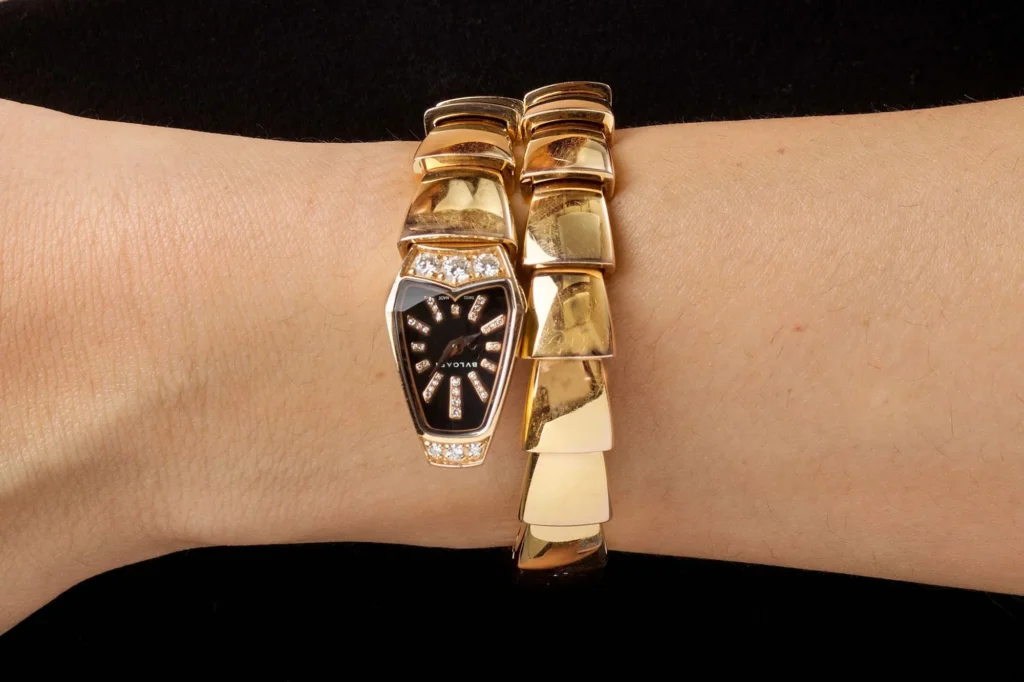
Serpenti kept evolving through the 1970s and beyond. Tubogas stayed a central technique, with Bulgari experimenting with different combinations of gold and, later, other materials, interpreted sometimes as a sophisticated jewellery cuff, sometimes as a more literal snake wrapped around the wrist. The technique proved especially valuable because it let Bulgari build a visual signature without making every Serpenti identical. A multi-wrap bracelet could look dramatic and sculptural. A simpler single-wrap version could feel more understated. Different metals and finishes could push the design from traditional high jewellery toward something more contemporary, which kept Serpenti from getting stuck in its own history.
Serpenti becomes a jewellery universe
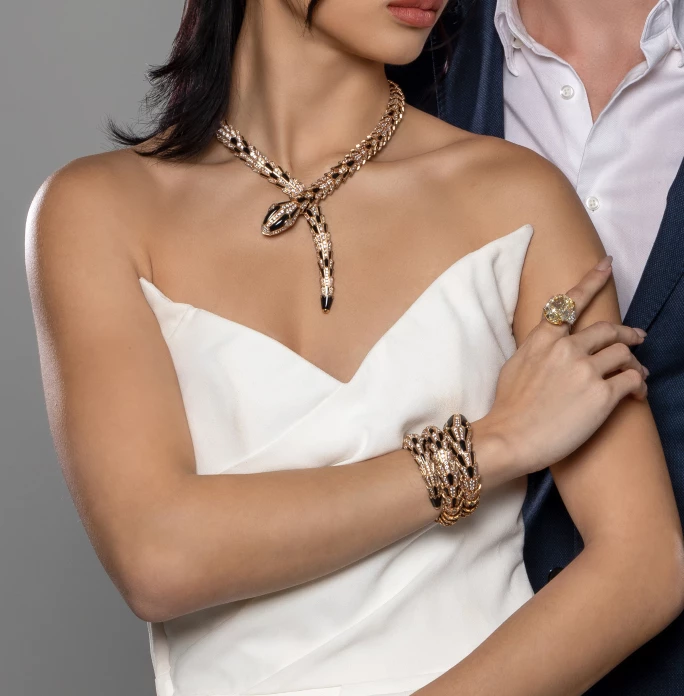
Eventually the serpent escaped the wrist entirely. Bulgari applied the motif across necklaces, bracelets, rings and other jewellery. The body could wrap a finger, climb a wrist or form the structure of a necklace. High-jewellery versions could be covered in diamonds or coloured gemstones, while more accessible designs kept the essential silhouette in a simpler form. That expansion mattered. Serpenti stopped being just a famous watch design and became a visual language for the whole maison, a distinction shared by only a handful of luxury motifs: Chanel has the camellia, Cartier has the panther, Van Cleef & Arpels has the Alhambra. For Bulgari, the serpent occupies that same territory, recognisable even before the maison’s name comes into view.
The modern Serpenti
Bulgari’s modern collections show how much room is still left in the original concept. In 2010, the house brought the serpent head and Tubogas body together in the Serpenti Tubogas collection, a contemporary take on the design’s historic architecture. Later came Serpenti Twist Your Time, which introduced leather straps into the mix. Other branches explore different interpretations. Serpenti Seduttori pairs the recognisable serpent head with a more conventional bracelet structure. Serpenti Spiga reinterprets the collection through a graphic pattern inspired by wheat.
From quartz to mechanical movements
Serpenti’s watchmaking story has changed a lot too. For much of the modern era, many Serpenti watches ran on quartz movements, which made sense given how compact the serpent-shaped cases are. Fitting a mechanical movement into that little space is a real technical challenge.
Bulgari has increasingly tackled that challenge through its own watchmaking. The maison’s move into integrated manufacturing followed acquisitions including Gérald Genta and Daniel Roth, and its Swiss facilities let Bulgari develop increasingly sophisticated in-house movements. That expertise has now reached Serpenti directly.
In 2023, Bulgari introduced the tiny Piccolissimo hand-wound movement, and the collection has since received highly complicated mechanical executions. In 2025, the maison introduced the BVS100 automatic movement, built specifically around the constraints of Serpenti’s small watch heads. The modern Serpenti isn’t just a jewellery watch with a decorative identity anymore. Some versions are genuine demonstrations of miniature mechanical watchmaking.
Why collectors continue to pursue Serpenti
Serpenti’s appeal in the collector market comes from a mix of recognisability, history and variety. Vintage examples offer a direct link to the collection’s formative decades, while contemporary high-jewellery pieces show how far Bulgari’s craftsmanship has come. Auction results back that up. Sotheby’s notes a diamond Serpenti bangle sold for CHF 342,900 in May 2025, and a diamond Serpenti necklace sold for CHF 304,800 in the same sales period.
But the fascination isn’t purely financial. Collectors are drawn to Serpenti because no two generations tell quite the same story. A 1950s secret watch, a 1970s Tubogas model and a contemporary high-jewellery serpent can look radically different while staying unmistakably related, which is genuinely hard to pull off in luxury design.
An icon that refuses to stand still
Bulgari Serpenti’s staying power comes down to one idea: the serpent is a motif with almost unlimited range. It can read as elegant or provocative, discreet or extravagant, a few curves of gold or an elaborate construction of diamonds, enamel and coloured gemstones. And it carries a history that predates Bulgari by thousands of years.
Written By: Leah Kim
Published On: 24th August 2026