
Luxury is entering a new era where innovation matters just as much as heritage. The potential collaboration between Google and Gucci represents more than a partnership. It signals a shift in how status is defined in a digital world. As technology becomes more embedded in everyday life, luxury brands are no longer just competing on aesthetics. They are competing on intelligence, connectivity, and experience.
A Strategic Collision of Two Worlds
The intersection of Big Tech and high fashion is not accidental. It is a calculated response to changing consumer expectations and market pressures. When Kering, the parent company of Gucci, began exploring advanced wearable technology with Google, it highlighted a clear ambition. Luxury brands want to remain culturally dominant in a world increasingly shaped by digital innovation.
For decades, Gucci built its identity on craftsmanship, bold design, and cultural influence. Google, by contrast, built its empire on data, algorithms, and scalability. Bringing these two forces together creates a hybrid that blends emotional appeal with technical capability. It is not just about creating a stylish gadget. It is about redefining what a luxury product can be.
This collaboration also reflects a broader shift in competitive dynamics. Luxury brands are no longer only competing with each other. They are competing with tech companies for consumer attention and relevance. A high net worth consumer today might value a cutting edge wearable just as much as a traditional luxury accessory. By partnering with Google, Gucci positions itself at the centre of this new battleground, where innovation becomes a key driver of desirability. At the same time, the collaboration allows both companies to address their weaknesses. Google gains access to design expertise and brand storytelling that it has historically lacked. Gucci gains technological credibility and the ability to integrate advanced features into its products. The result is a strategic alignment where both sides enhance their value proposition.
Redefining Luxury Through Functionality
The idea of luxury has long been tied to exclusivity and craftsmanship. However, the rise of smart technology is introducing a new dimension. Functionality is becoming just as important as form. A luxury item is no longer defined solely by how it looks or feels, but by what it can do.
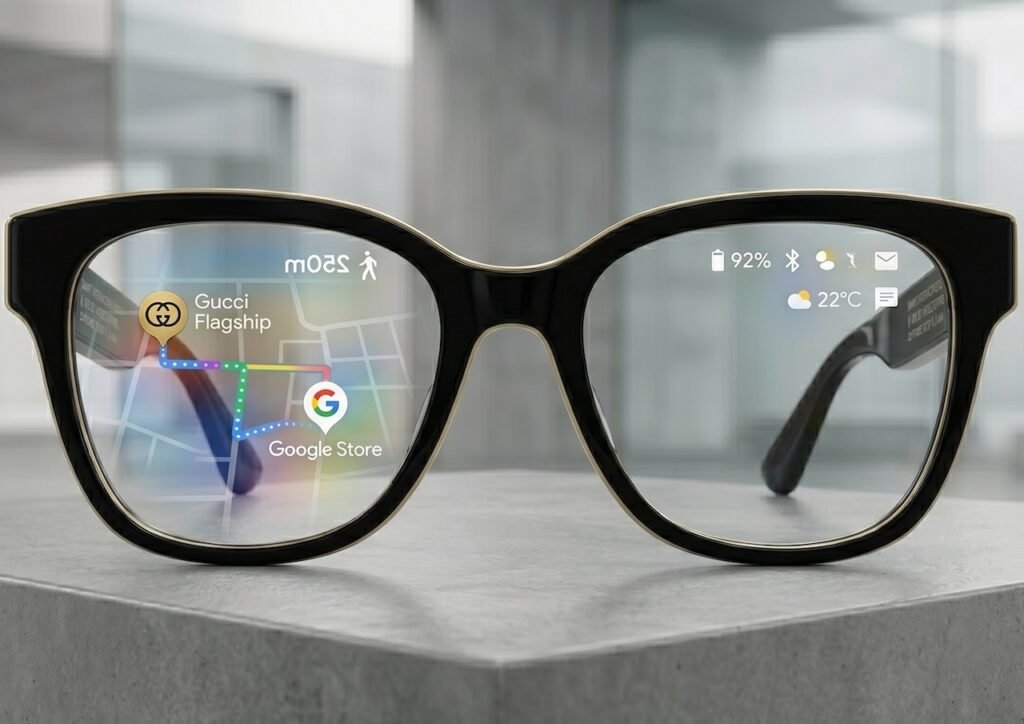
In the case of a Google and Gucci collaboration, this could take the form of high end smart glasses or wearable devices that seamlessly integrate into daily life. Imagine a product that offers real time information, augmented reality features, and personalised AI assistance, all wrapped in a design that reflects Gucci’s distinctive aesthetic. This is not just an accessory. It is an extension of the user’s capabilities.This shift aligns with the preferences of younger luxury consumers. Millennials and Gen Z are less interested in static displays of wealth and more focused on experiences and utility. They value products that enhance their lifestyle and reflect their identity in a dynamic way. A tech enabled luxury item satisfies both needs. It provides practical benefits while also serving as a status symbol.
There is also a deeper psychological element at play. Owning a technologically advanced product signals not just wealth, but also intelligence and forward thinking. It suggests that the user is not only successful, but also ahead of the curve. In this sense, functionality itself becomes a form of luxury. The ability to access information, optimise time, and navigate the world more efficiently is increasingly seen as a privilege.The Future of Fashion in a Connected World
The potential success of a Google and Gucci partnership could reshape the entire luxury industry. If tech enabled fashion becomes mainstream at the high end, other brands will be forced to follow. This could lead to a wave of collaborations between fashion houses and technology companies, fundamentally changing the landscape of luxury.
However, this evolution is not without challenges. One of the core tensions lies in the lifecycle of technology versus the timelessness of luxury. Tech products become outdated quickly, while luxury items are designed to last for years, even decades. Bridging this gap will require innovation not just in design, but also in business models. Concepts such as modular upgrades, software updates, and limited edition releases could play a key role in maintaining relevance over time.
There is also the question of authenticity. Luxury brands have built their reputations on heritage and craftsmanship. Integrating technology risks diluting this identity if not done carefully. The challenge for Gucci will be to ensure that any tech collaboration feels like a natural extension of its brand, rather than a departure from it. This requires a careful balance between innovation and tradition.
Despite these challenges, the direction is clear. The boundaries between industries are dissolving, and the most successful brands will be those that can adapt to this new reality. The collaboration between Google and Gucci is not just a product experiment. It is a glimpse into the future of luxury, where fashion is not only seen and felt, but also experienced through technology.
In this emerging landscape, the definition of status is evolving. It is no longer enough to own something rare or beautiful. True luxury lies in owning something that enhances your life in meaningful ways. If Google and Gucci succeed, they will not just create a new category of products. They will redefine what it means to be luxurious in the digital age.
Written By: Mia Quisumbing
Published On: 22nd April 2026