
In Singapore, where urban energy and contemporary hospitality continue to evolve side by side, Raffles Sentosa Singapore introduces a new perspective on luxury retreat living. Positioned within the greenery of Sentosa Island, the property offers a setting that feels removed from the pace of the city while remaining deeply connected to its identity.

The experience is shaped by privacy, landscape, and refined design. Rather than focusing on scale or spectacle, the resort creates an atmosphere defined by calm and intention.
Here, luxury becomes an experience of balance.
A Retreat Within the City

Sentosa has long been associated with leisure and escape, offering a different rhythm from the centre of Singapore.
Raffles Sentosa builds on this context by creating a retreat that feels immersive yet accessible. The surrounding greenery, open space, and tropical landscape establish an environment that contrasts with the density of the urban skyline.
This relationship between city and nature defines the identity of the resort.
Guests are able to experience a sense of seclusion without disconnecting entirely from Singapore itself.
The Evolution of the Raffles Identity
Raffles is a name deeply connected to hospitality heritage.
With Raffles Sentosa, the brand introduces a more contemporary interpretation of its identity while maintaining the refinement associated with the maison.
The property moves away from the formality often linked to traditional luxury hotels, instead embracing a softer and more residential atmosphere.
This evolution reflects changing expectations within the luxury travel landscape, where comfort and privacy increasingly shape the guest experience.
Design Rooted in Simplicity

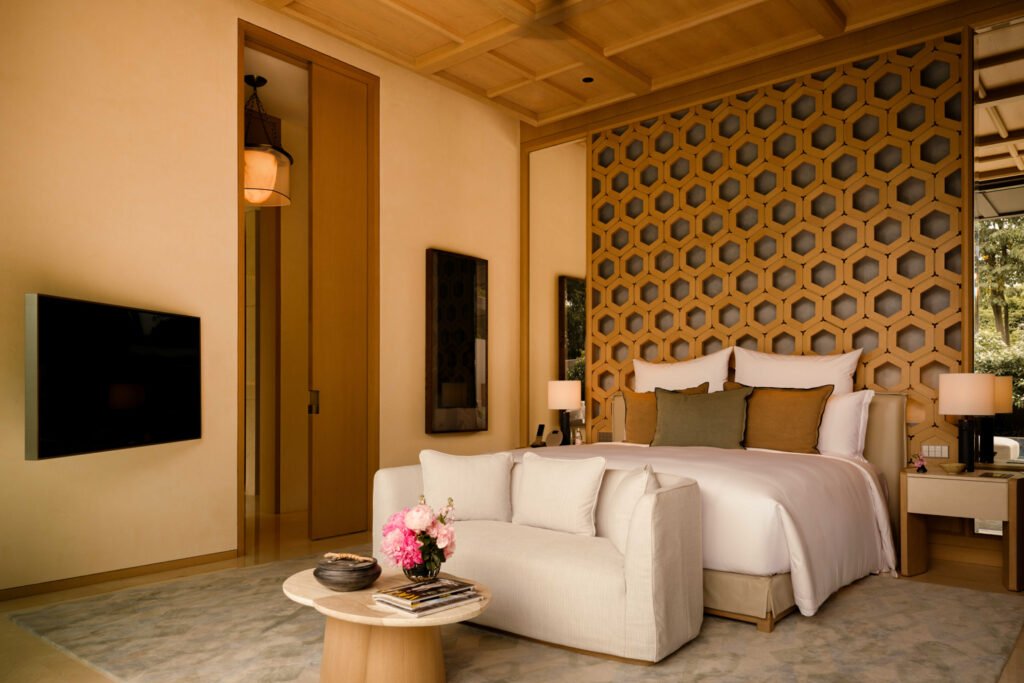
The design of Raffles Sentosa reflects a restrained and contemporary aesthetic.
Natural materials, warm textures, and soft lighting create spaces that feel both refined and relaxed.
Large windows and open layouts establish a strong connection between interior and exterior environments.
The architecture does not dominate the landscape. Instead, it integrates with it, allowing the surrounding greenery to remain central.
This approach creates a sense of continuity that defines the visual identity of the resort.
Villas and Private Living

Privacy forms a central part of the experience at Raffles Sentosa.
The resort’s villas are designed to feel self contained, offering guests a sense of personal space rarely associated with city destinations.
Private pools, outdoor areas, and spacious interiors contribute to an atmosphere that feels calm and uninterrupted.
This residential approach reflects a broader movement within luxury hospitality, where travellers increasingly seek environments that feel intimate rather than highly structured.
Wellness and Atmosphere

Wellness is integrated into the overall experience of the property.
The setting itself encourages a slower pace, where guests are invited to engage with their surroundings through stillness rather than activity.
Spa experiences, quiet spaces, and the natural environment contribute to a sense of restoration.
This perspective aligns with the evolving definition of luxury travel, where emotional and physical wellbeing become central to hospitality.
Singapore Through a Different Lens
Raffles Sentosa offers a perspective on Singapore that differs from the city’s more familiar image of modern architecture and urban intensity.
Here, the emphasis is placed on nature, atmosphere, and retreat.
The property reveals another dimension of the destination, one shaped by tropical landscape and understated design.
This contrast adds depth to the broader experience of Singapore as a luxury destination.
A Refined Sense of Escape
What defines Raffles Sentosa Singapore is its ability to create distance without isolation.
The resort exists between city and nature, heritage and contemporary design, structure and ease.
This balance shapes the overall experience, allowing luxury to feel understated rather than performative.
In this setting, refinement is expressed quietly, through atmosphere, space, and the relationship between architecture and environment.
Written by: Linh Giang Nguyen
Published on: 6 May 2026